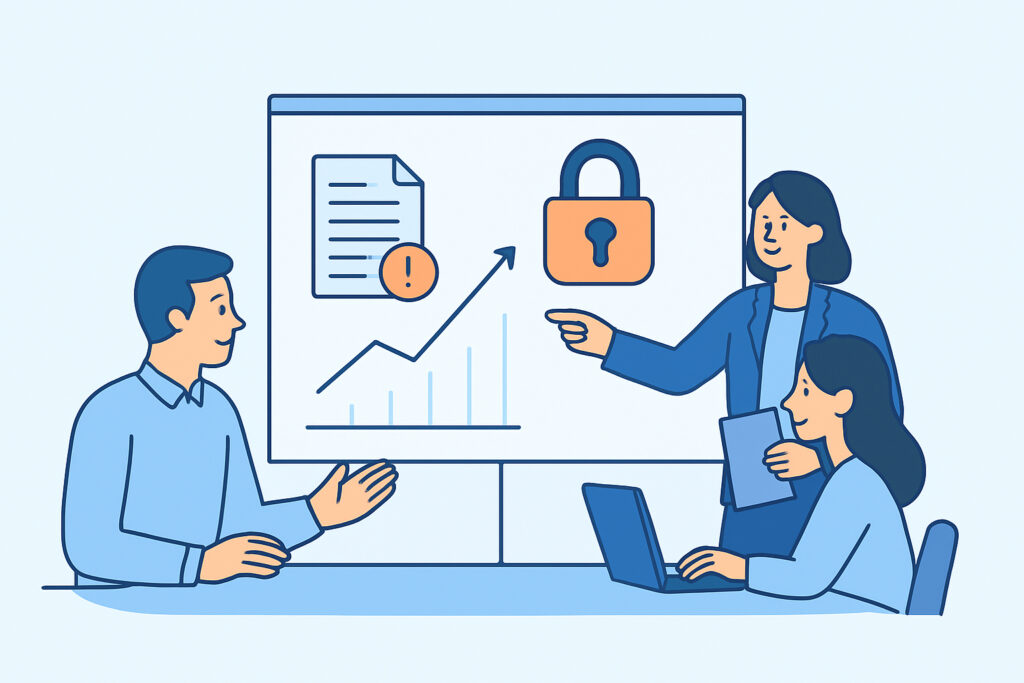
The alert fires, the team scrambles, credentials get rotated, and within seventy-two hours the fire is out. Then everyone goes back to their normal work and the post-incident review never happens – or happens as a fifteen-minute call where someone says “let’s make sure this doesn’t happen again” and nobody writes down how. That gap between putting out the fire and actually learning from it is where most organizations quietly repeat the same mistakes eighteen months later.
A proper post-incident review is not a formality bolted onto the end of a leak response. It is the mechanism that converts a bad week into a durable improvement in how the organization detects, contains, and prevents exposure. Skip it, and every leak becomes a one-off crisis instead of a data point in a pattern you could have caught earlier.
Why post-incident reviews get skipped
The most common reason is fatigue. By the time credentials are rotated, access is revoked, and legal has been briefed, the team is exhausted and relieved. Nobody wants to relive the incident in a meeting.
The second reason is fear. If the review turns into a hunt for who to blame, people stop being honest about what actually happened – which timestamps were fudged, which alert got snoozed, which access request slipped through without a second approval. A review built around blame produces a sanitized narrative, not a useful one.
The third reason is simpler: there’s no process for it. Many incident response plans stop at containment and notification. The learning phase is assumed to happen informally, and informal almost always means it doesn’t happen at all.
What a post-incident review should actually cover
A useful review answers five questions, in this order:
What happened, in a strict timeline. When was the data exposed, when was it discovered, when was it contained, and when was it fully remediated. Pull these timestamps from logs and monitoring alerts, not from memory – people reconstruct timelines wrong more often than they’d expect.
How was it discovered. Internal monitoring, an external tip, a customer complaint, a journalist, or – worse – the attacker announcing it themselves. This single data point tells you more about your detection maturity than almost anything else in the review.
What was the gap between exposure and discovery. If a credential sat exposed in a public repository for forty days before anyone noticed, that gap is the real story, not the eventual rotation. The response you took after discovery matters less than the detection lag before it.
What worked. Reviews that only list failures breed defensiveness. If the on-call engineer escalated correctly within ten minutes, say so. Reinforcing good behavior is part of building a team that reports problems early instead of hiding them.
What needs to change, with an owner and a date. Vague action items like “improve monitoring coverage” die quietly. Specific ones – “add secrets scanning to the CI pipeline for repo X by end of month, owned by the platform team” – survive.
Running the review without turning it into a blame session
Set the ground rule explicitly at the start: this is a systems review, not a performance review. If an employee clicked a phishing link or committed a credential to a public branch, the question isn’t “why did they do that” but “why did the system allow that mistake to become a leak.” Individual errors are inevitable; the goal is a process resilient enough to catch them before they cause damage.
Bring in people from outside the immediate response team. A developer who wasn’t involved will ask questions the incident commander won’t think to ask, precisely because they don’t already know the “obvious” answer. This is the same logic behind running a data leak tabletop exercise with participants who weren’t part of the original scenario design – fresh eyes surface blind spots that insiders have stopped seeing.
Document the review in writing, even if it’s short. A one-page summary with the timeline, root cause, and action items is more useful six months later than anyone’s memory of the meeting.
The myth that rotation and notification are the finish line
A persistent misconception is that once credentials are rotated and affected parties are notified, the incident is closed. In practice, remediation and learning are two different phases with two different purposes. Remediation stops the immediate bleeding. Learning prevents the next occurrence – whether that’s the same vulnerability reappearing in a different repository, the same vendor leaking a different dataset, or the same detection gap missing the next exposure for another six weeks.
Monitoring also doesn’t stop at remediation. Leaked credentials get recycled into combolists and resold months after the original incident, so the exposure surface from one leak can resurface long after the case is officially closed – which is why monitoring needs to continue after breach remediation rather than winding down once the immediate response ends.
Turning findings into structural change
The output of a good review usually falls into three buckets: detection gaps, process gaps, and access gaps. Detection gaps mean a data source wasn’t being watched – an internal wiki, a code repository, a paste site where credentials surfaced before anyone internally knew. Process gaps mean the right people didn’t get looped in fast enough, which is often solved by referencing (and rehearsing) an incident response playbook for data leak discoveries rather than improvising escalation paths mid-crisis. Access gaps mean too many people or systems had standing access to something that should have been scoped down.
Track these findings across incidents, not just within one. A single review might show that detection lagged by three weeks. Three reviews over a year might show detection lag is consistently the weak point across every incident type – which is a budget and tooling conversation, not a one-time fix.
Frequently asked questions
How soon after an incident should the post-incident review happen?
Within one to two weeks of full remediation. Wait too long and details fade or get reconstructed inaccurately; rush it while the team is still firefighting and the review becomes shallow.
Who should attend a post-incident review?
The incident response team, at least one person from outside the immediate response (for perspective), and a decision-maker who can actually approve resourcing for the resulting action items. Legal or compliance should attend if the leak involved regulated data.
What’s the biggest sign a post-incident review process is failing?
The same root cause showing up in two separate incidents. If a review process is working, findings get fixed and don’t recur; if the same gap keeps producing new incidents, either the action items aren’t being implemented or the review isn’t asking the right questions.
Every leak carries a lesson, but only if someone deliberately extracts it instead of letting the incident close on relief alone. Build the review into the incident process itself, staff it with people who’ll ask uncomfortable questions, and track the findings across incidents rather than treating each one as isolated. That discipline is what separates organizations that keep having the same leak from ones that actually get harder to breach over time.