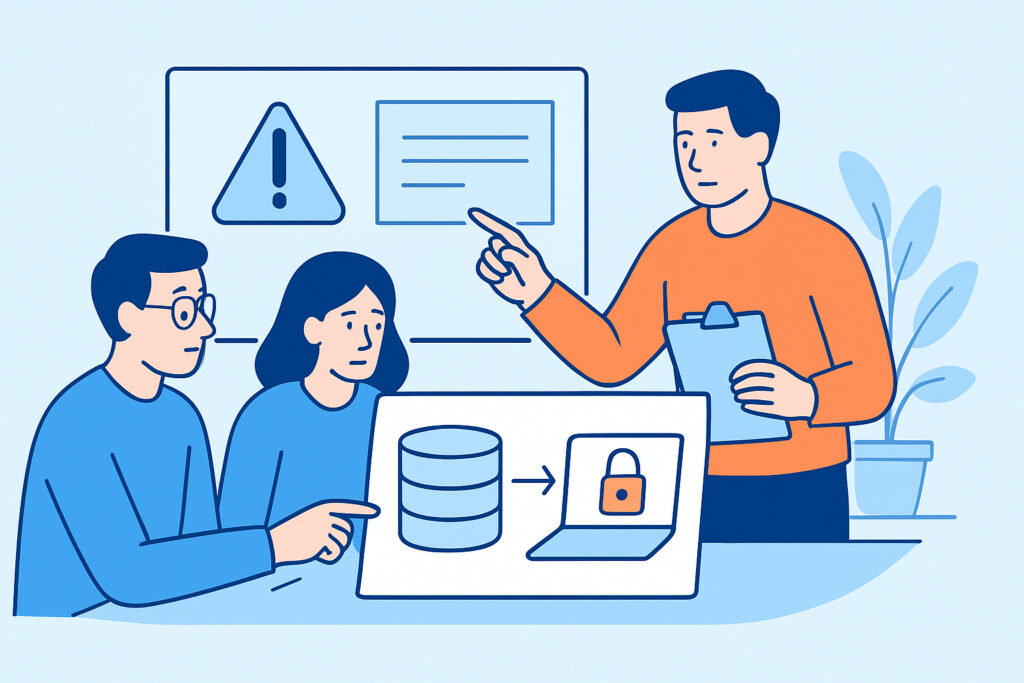
A data leak tabletop exercise is one of the most practical ways to find out whether your organization can actually respond to a breach – not just whether your documentation says it can. This article walks through how to design, run, and debrief a realistic tabletop exercise focused specifically on data leak scenarios, so your team is prepared before an incident happens rather than during one.
Security teams spend significant effort on detection tools and policies, but real readiness gaps usually surface under simulated pressure. When a tabletop exercise is done right, it exposes decision-making delays, unclear ownership, and communication breakdowns that no audit checklist will catch.
What a Data Leak Tabletop Exercise Actually Tests
A tabletop exercise is a structured, discussion-based simulation where participants walk through a realistic incident scenario step by step. Nobody is writing code or triggering systems – the team talks through what they would do, who would make which decisions, and how they would communicate internally and externally.
For data leak scenarios specifically, the exercise should test several things at once: technical detection and triage, internal escalation paths, legal and regulatory obligations, and external communication with customers or regulators. Most organizations are reasonably good at one or two of these – almost none are consistently good at all four.
The value isn’t in finding out who performs best. It’s in finding the seams where the process falls apart.
Common Myths About Tabletop Exercises
Myth: A tabletop exercise is just a meeting where everyone agrees things would go fine.
This is the most common reason tabletop exercises fail to deliver value. If the facilitator isn’t pushing with difficult injects – unexpected complications mid-scenario – the team naturally gravitates toward the optimistic path. Real incidents don’t do that.
Another persistent myth is that tabletop exercises are only useful for large enterprises with dedicated security teams. In practice, smaller organizations often benefit more, because they typically have fewer written procedures and more informal assumptions about who does what during a crisis.
Choosing a Realistic Scenario
The scenario is the foundation of the exercise. A vague or overly technical scenario won’t generate useful discussion. A well-crafted one should feel uncomfortably plausible.
Some scenario types that work well for data leak tabletops:
Credential dump discovered on a hacker forum. Your monitoring system flags that employee email/password combinations from your company domain have appeared in a public dump. The data appears to be 6 months old. What do you do?
Third-party vendor notifies you of a breach. A SaaS provider used by your HR team confirms they’ve suffered a breach and that your employee data was likely included. You have no independent visibility into what was exposed.
Internal document found indexed by search engines. A sensitive product roadmap document is discoverable via a basic Google search. You don’t know how long it’s been there, how many people have seen it, or whether it was shared intentionally.
GitHub leak of configuration files. An automated alert fires at 11pm on a Friday showing that a developer pushed environment variables including database credentials to a public repository. The commit has been there for 72 hours.
Each of these has multiple response branches and forces the team to make real decisions under uncertainty.
Who Should Be in the Room
The exercise only works if the right people participate. A security-only tabletop will miss the legal, HR, and communications decisions that are often more complex than the technical ones.
A well-rounded participant list typically includes: the security or IT lead, a legal or compliance representative, someone from communications or PR, an HR contact, and at least one senior business stakeholder. If your organization has a formal data leak response team, the tabletop should closely mirror that structure.
Keep the group small enough that everyone actively participates – 6 to 10 people is usually the right range. Observers are fine, but the exercise loses energy when too many people are passive.
Structuring the Exercise
A well-run data leak tabletop typically follows this structure:
1. Briefing (15 minutes). Set the ground rules. The exercise is blame-free. The goal is to find gaps, not to assess individual performance. Explain the scenario format and what injects are.
2. Scenario introduction (5 minutes). Present the initial situation. Keep it factual and brief. Don’t over-explain – the ambiguity is deliberate.
3. Discussion rounds (60–90 minutes). Work through the scenario in time-based segments. At each stage, introduce an inject that complicates the situation. Examples: the breach turns out to affect customers, not just employees. A journalist contacts your communications team before your internal investigation is complete. A regulatory deadline is now 48 hours away.
4. Debrief (30–45 minutes). This is where the real value is captured. Document every gap, assumption, and disagreement that surfaced. Don’t let the session end without specific action items assigned to specific people.
A structured incident response playbook should be referenced during the debrief to identify whether existing documentation covers what was discussed – and where it needs updating.
Injects That Expose Real Gaps
The inject is the facilitator’s most important tool. A good inject adds pressure, introduces ambiguity, or forces a decision that the team hasn’t explicitly planned for.
Examples of high-value injects for data leak tabletops:
– Your legal team advises that GDPR’s 72-hour notification window has already started. Can your team identify exactly what data was affected and notify the appropriate authority in time? Understanding who you must notify and when is often where teams discover the most uncertainty.
– The CEO wants to post a public statement immediately. Your communications person hasn’t finished their assessment yet. Who has final authority?
– A second, unrelated leak is discovered mid-investigation. How do you prioritize resources?
– The lead incident responder is unavailable. Is there documented backup coverage?
Measuring What You Learn
After the exercise, capture findings in three categories: gaps in process (steps that don’t exist or aren’t documented), gaps in tools (detection or communication capabilities that were assumed but not confirmed), and gaps in knowledge (things participants assumed others knew, but nobody actually did).
Assign each finding an owner and a realistic remediation timeline. A tabletop exercise that produces a list with no owners is just documentation theater.
Run the exercise at least annually. If your organization experiences a significant change – a new SaaS platform, a merger, a major personnel change in the security team – run it again. Threat landscapes shift, and so do your internal assumptions.
Frequently Asked Questions
How long should a data leak tabletop exercise take?
A focused, single-scenario tabletop typically runs 2 to 3 hours including briefing and debrief. Longer exercises covering multiple scenarios can run a full day, but diminishing returns set in quickly after the 4-hour mark. Most organizations get better results from shorter, more frequent exercises than from one exhaustive annual session.
Do we need an external facilitator?
Not always, but it helps. An internal facilitator can run an effective exercise, especially after the first one. The risk with internal facilitation is that the person running the scenario may unconsciously steer discussion toward comfortable conclusions. An external facilitator – or at minimum someone from outside the immediate security team – tends to push harder on gaps.
What should we do if a real incident occurs shortly after the exercise?
Use it. The timing is often uncomfortable, but the team will have fresher instincts around decisions and escalation paths than they would otherwise. Document whether the real incident revealed gaps the tabletop missed – that information is valuable for the next exercise design.
Turning Findings Into Stronger Defenses
A tabletop exercise is most valuable when it drives change, not just reflection. The gaps it reveals – unclear ownership, missing playbook steps, regulatory confusion, untested detection assumptions – are exactly the things that cause real incidents to spiral.
Run the exercise, document honestly, assign owners, and verify fixes. Then do it again. The teams that handle data leak incidents well aren’t the ones with the best tools – they’re the ones who’ve already argued through the hard decisions before the clock is running.
{
“@context”: “https://schema.org”,
“@type”: “FAQPage”,
“mainEntity”: [
{
“@type”: “Question”,
“name”: “How long should a data leak tabletop exercise take?”,
“acceptedAnswer”: {
“@type”: “Answer”,
“text”: “A focused, single-scenario tabletop typically runs 2 to 3 hours including briefing and debrief. Longer exercises covering multiple scenarios can run a full day, but diminishing returns set in quickly after the 4-hour mark. Most organizations get better results from shorter, more frequent exercises than from one exhaustive annual session.”
}
},
{
“@type”: “Question”,
“name”: “Do we need an external facilitator?”,
“acceptedAnswer”: {
“@type”: “Answer”,
“text”: “Not always, but it helps. An internal facilitator can run an effective exercise, especially after the first one. The risk with internal facilitation is that the person running the scenario may unconsciously steer discussion toward comfortable conclusions. An external facilitator – or at minimum someone from outside the immediate security team – tends to push harder on gaps.”
}
},
{
“@type”: “Question”,
“name”: “What should we do if a real incident occurs shortly after the exercise?”,
“acceptedAnswer”: {
“@type”: “Answer”,
“text”: “Use it. The timing is often uncomfortable, but the team will have fresher instincts around decisions and escalation paths than they would otherwise. Document whether the real incident revealed gaps the tabletop missed – that information is valuable for the next exercise design.”
}
}
]
}