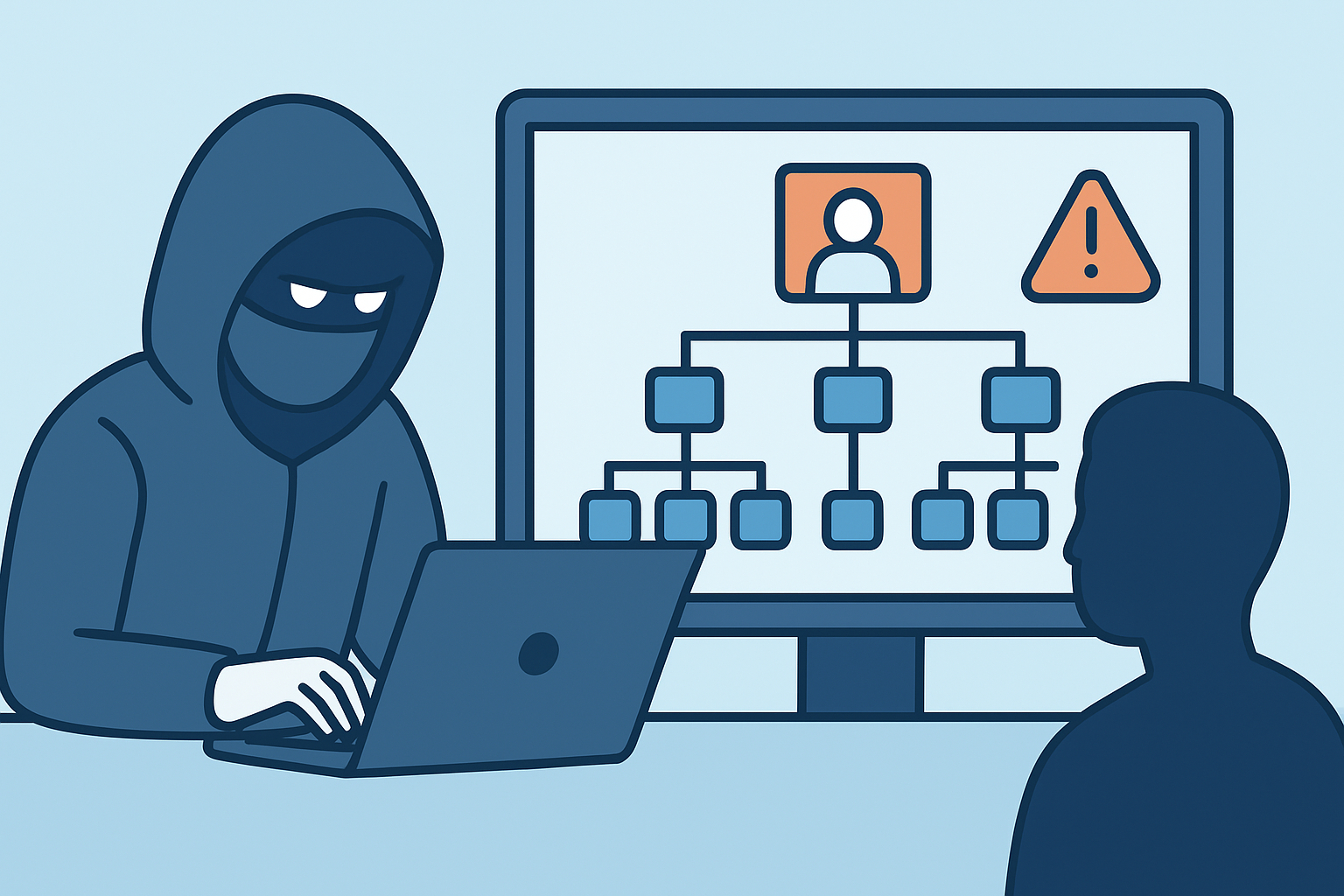
Leaked org charts are one of the most underestimated intelligence assets available to threat actors planning targeted attacks against your organization. While much attention goes to stolen credentials and exposed databases, a leaked organizational chart hands attackers a precise map of your company’s human infrastructure – who reports to whom, who holds sensitive access, and who makes financial decisions.
Why Org Charts Are High-Value Reconnaissance Data
An org chart is essentially a targeting guide. It tells attackers which employees are likely to have access to financial systems, HR records, or technical infrastructure – without requiring any technical exploitation.
Attackers use this information to prioritize targets, craft believable pretexts, and avoid wasting effort on employees who can’t fulfill their objectives. A CFO’s direct reports, an IT administrator’s team, and a legal counsel’s assistants are all immediately identifiable from a well-structured org chart.
This kind of social intelligence feeds directly into spear phishing, business email compromise, and vishing campaigns. The attacker already knows the chain of command before the first malicious email is sent.
Where Leaked Org Charts Come From
Org charts surface in more places than most security teams monitor. Internal wikis – particularly Confluence and Notion pages – are a common source, especially when access controls are misconfigured or when a departing employee exports documents without oversight.
File-sharing platforms, accidentally public SharePoint folders, and cloud storage buckets frequently contain HR documentation that includes org charts. During mergers and acquisitions, org charts often circulate across multiple parties and can end up in unsecured data rooms.
LinkedIn, while public by design, provides attackers with a continuously updated and self-maintained version of your org chart. Employees add their manager’s names, update their titles, and connect with colleagues – effectively rebuilding the hierarchy that you may never have explicitly shared externally.
The Attack Chains That Org Charts Enable
Once an attacker has a clear picture of your organizational structure, several well-established attack patterns become significantly easier to execute.
Business email compromise (BEC): Knowing that a finance director reports to a specific VP allows the attacker to impersonate the VP with high precision. The request feels legitimate because the attacker knows the actual names, titles, and approval chains. This is why executive impersonation attacks are so difficult to detect before the damage is done.
Spear phishing with authority: Attackers craft emails that reference the target’s actual manager by name, mention a plausible project, and invoke urgency from a known executive. Without the org chart, this level of specificity isn’t possible.
Credential prioritization: When attackers acquire a set of employee email addresses from a breach, an org chart tells them which accounts are worth targeting first. A systems administrator in the infrastructure team is a higher-value target than an entry-level marketing analyst.
Social engineering via phone: Vishing attackers call employees and claim to be from IT support, HR, or the C-suite. Knowing the org chart makes the impersonation credible – the caller can reference the target’s actual manager, team name, and internal terminology.
A Realistic Attack Scenario
Consider a mid-size financial services firm. An attacker finds a PDF org chart on an improperly secured SharePoint site – indexed by a search engine, discoverable in under five minutes. The document shows the name and email of the CFO, their executive assistant, and the three direct reports in the finance team.
The attacker sends a carefully worded email to the EA, purportedly from the CFO, requesting an urgent wire transfer for a time-sensitive acquisition. The EA, recognizing the CFO’s name and knowing the org structure is accurate, processes the request before IT has any visibility. The company loses $200,000 before the fraud is flagged three days later.
This scenario is not hypothetical – it plays out regularly. The org chart isn’t the only tool used, but it’s often what transforms a generic attack into a successful one.
The Myth That LinkedIn Makes Org Charts Public Anyway
A common pushback from security teams is: “Our org chart is basically public because of LinkedIn – there’s nothing to protect.” This misunderstands the threat model.
LinkedIn provides partial, fragmented data that requires active correlation. A leaked internal org chart provides a complete, structured, and verified snapshot – including roles that employees deliberately keep off LinkedIn, internal team names, reporting lines, and sometimes contact details for staff who have no public presence at all.
The difference between a partial picture and a complete one is significant. Attackers who correlate LinkedIn data with leaked credentials and internal documentation are building far more accurate targeting profiles than LinkedIn alone would allow.
How to Reduce the Risk
The goal isn’t to make org charts secret – it’s to control where they live and who can access them outside the organization.
Audit where org charts are stored. Check SharePoint, Confluence, Notion, Google Drive, and any file-sharing platforms for documents containing names, titles, and reporting lines. Set access controls to restrict external sharing.
Apply data classification to HR documentation. Org charts, employee directories, and role descriptions should be treated as sensitive internal data – not freely distributable within the organization without controls.
Monitor for external exposure. Use automated data leak monitoring to flag when documents matching your internal naming conventions or containing employee names and titles appear on public sources. Catching a leaked org chart within hours is very different from finding out about it six months later.
Train staff on social engineering. Employees who understand how org chart information is used in BEC and vishing attacks are more likely to pause before acting on an unusual request, even when it appears to come from a known executive.
Revoke outdated versions. When reporting lines change, update and revoke older versions of org charts. Stale documents that reflect accurate historical information are still useful to attackers and may circulate long after the original was updated internally.
Frequently Asked Questions
How do attackers find leaked org charts?
They use search engines with specific queries targeting file types and keywords – a technique known as Google Dorking – and also scan exposed cloud storage buckets, monitor paste sites, and purchase leaked corporate documents on criminal forums. In many cases, the document was never intended to be public; it simply ended up somewhere without access controls.
Is an org chart subject to GDPR protection?
Yes. Org charts contain personal data – names, roles, contact details – and organizations have an obligation to ensure this data is not exposed to unauthorized parties. A leaked org chart that enables a targeted attack could also trigger breach notification obligations depending on the downstream impact.
Can automated monitoring detect a leaked org chart?
Broad data leak detection platforms monitor for document types, email domains, and employee name patterns that can indicate an org chart or employee directory has surfaced externally. The challenge is matching exposure indicators to specific internal documents – which is why combining automated monitoring with periodic manual audits gives the most complete coverage.
Treat Organizational Intelligence as Sensitive Data
Most organizations focus data leak monitoring on credentials, source code, and customer records. Organizational intelligence – who works where, who reports to whom, and who holds what access – rarely gets the same attention. Attackers know this.
An org chart doesn’t need to contain passwords to be dangerous. It contains the contextual knowledge that makes every other attack more effective. Treating it as a sensitive asset – and actively monitoring for its exposure – closes a gap that most security programs leave wide open.