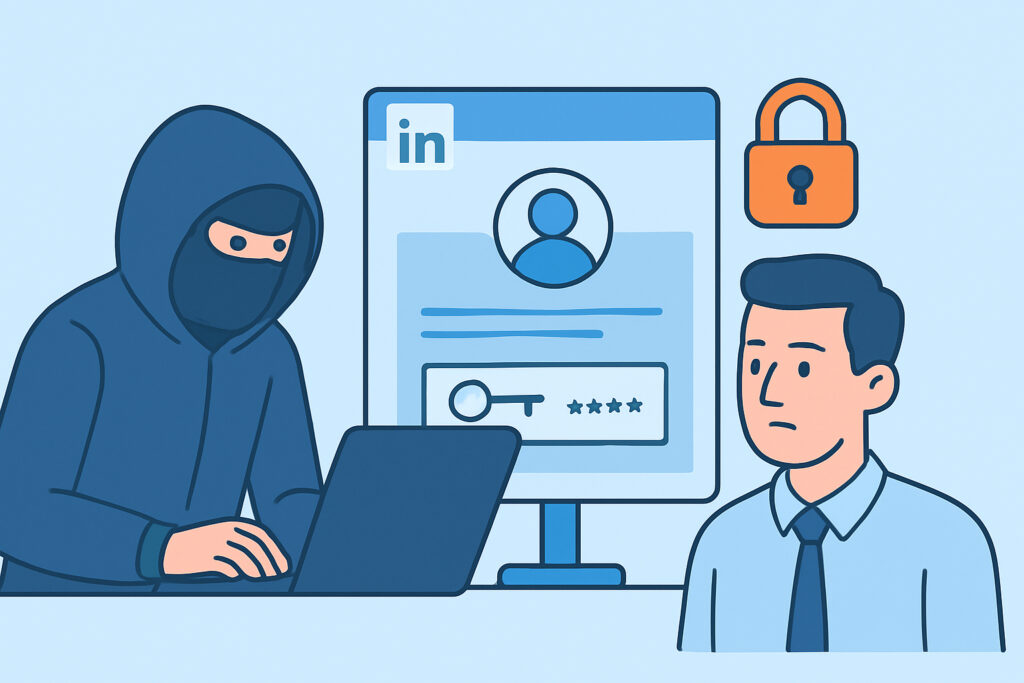
Understanding how attackers use LinkedIn to validate stolen credentials is crucial for security teams defending against targeted attacks. This professional networking platform has become an unexpected tool in the cybercriminal toolkit, transforming from a career development resource into a reconnaissance goldmine for threat actors looking to maximize the value of compromised account data.
When cybercriminals obtain credentials from data breaches or credential dumps, they face a fundamental challenge: determining which stolen accounts belong to high-value targets within organizations. LinkedIn solves this problem by providing detailed professional profiles that allow attackers to identify employees’ roles, responsibilities, and organizational hierarchies.
The LinkedIn Reconnaissance Process
The validation process begins when attackers acquire credential databases from underground marketplaces. These datasets often contain millions of email-password combinations, but lack context about the account holders’ professional significance.
Attackers systematically search LinkedIn using email addresses from stolen credential lists. A typical validation workflow involves checking whether an email address corresponds to a LinkedIn profile, then examining the profile to assess the target’s organizational value. Senior executives, IT administrators, and finance personnel receive priority attention due to their elevated access privileges.
The process reveals critical information: job titles, company names, department structures, and professional connections. A stolen credential for “jsmith@company.com” transforms from anonymous data into “John Smith, Chief Financial Officer at Fortune 500 Corporation” – dramatically increasing its market value and attack potential.
Professional networks also expose organizational relationships. Attackers map reporting structures, identify team members, and discover potential lateral movement paths within target companies. This intelligence gathering occurs entirely through public information, making it difficult to detect or prevent.
Timing and Targeting Strategies
Speed matters in credential validation. Experienced threat actors know that companies eventually discover breaches and force password resets. The window between credential theft and account lockdown typically ranges from weeks to months, creating urgency around the validation process.
Attackers prioritize validation efforts based on email domains. Corporate email addresses receive immediate attention, while consumer webmail accounts get lower priority. Domains associated with large enterprises, government agencies, or high-profile organizations trigger intensive LinkedIn searches.
The validation process also considers account age and activity levels. Dormant LinkedIn profiles might indicate inactive employees, reducing the credentials’ value. Conversely, recently updated profiles with extensive professional networks suggest active, potentially valuable targets.
Geographic factors influence targeting decisions. Attackers often focus on specific regions or countries based on their operational capabilities, language skills, or market demand for particular types of access.
Enhanced Attack Vectors Through Social Engineering
LinkedIn profiles provide ammunition for sophisticated social engineering campaigns. Attackers craft convincing phishing emails using legitimate professional details gathered from target profiles. A message appearing to come from a colleague mentioned in someone’s LinkedIn connections carries significantly more credibility than generic phishing attempts.
Professional accomplishments, recent job changes, and industry involvement become talking points for building rapport during voice-based social engineering attacks. Attackers reference specific projects, mutual connections, or industry events to establish credibility before requesting sensitive information or system access.
The platform’s messaging system creates direct communication channels with potential targets. Attackers create fake profiles mimicking legitimate business contacts, then initiate conversations that gradually build toward credential harvesting or malware distribution.
Company pages reveal organizational structure, recent news, and employee lists. This information helps attackers understand business processes, identify additional targets, and craft attacks that align with current organizational priorities or concerns.
Common Misconceptions About LinkedIn Security
Many security professionals mistakenly believe that LinkedIn’s privacy settings provide adequate protection against reconnaissance activities. However, even restrictive privacy configurations leave substantial information visible to determined attackers. Basic profile elements like current employer, job title, and location remain accessible regardless of privacy preferences.
Another misconception involves the assumption that attackers only target senior executives. In reality, any employee with system access, financial responsibilities, or customer data handling duties represents a valuable target. Help desk personnel, accounts payable clerks, and junior developers often possess credentials that enable broader organizational compromise.
Organizations frequently underestimate the intelligence value of seemingly mundane professional information. Project details, technology stack mentions, and vendor relationships disclosed in LinkedIn profiles provide attackers with insights into potential attack vectors and system vulnerabilities.
Detection and Monitoring Challenges
Traditional security monitoring tools struggle to identify LinkedIn-based reconnaissance activities. The platform’s legitimate business purpose makes employee usage difficult to restrict, while attackers’ research activities appear indistinguishable from normal professional networking behavior.
Credential validation attempts blend seamlessly with LinkedIn’s regular traffic patterns. Automated tools searching for email addresses generate minimal suspicious indicators, especially when distributed across multiple accounts and IP addresses. This invisibility allows sustained reconnaissance operations without triggering security alerts.
Comprehensive monitoring approaches must account for the correlation between credential exposure and social media intelligence gathering. Detecting this connection requires analyzing multiple data sources simultaneously rather than examining individual platforms in isolation.
Organizations need visibility into their employees’ professional profiles that might be accessible to attackers. Regular audits should identify information that could facilitate targeted attacks, though balancing security concerns against legitimate professional networking needs requires careful consideration.
Mitigation Strategies and Best Practices
Employee education represents the first line of defense against LinkedIn-enabled attacks. Security awareness training should explicitly address how professional information gets weaponized by attackers. Employees need to understand the connection between their online professional presence and organizational security risks.
Profile optimization guidelines help employees maintain professional visibility while minimizing security exposure. Recommendations include avoiding detailed project descriptions, limiting technology stack disclosures, and carefully managing connection requests from unknown contacts.
Organizations should implement policies governing professional social media usage by employees in sensitive roles. These policies might restrict certain types of information sharing or require approval for external speaking engagements and publication activities that could reveal internal processes or technologies.
Regular security assessments should include LinkedIn reconnaissance simulations. Security teams can perform the same searches that attackers use, identifying employees whose public profiles create elevated risk exposure. This intelligence helps prioritize security awareness efforts and adjust monitoring strategies.
Multi-factor authentication becomes critical when credential validation activities are detected. Even if attackers successfully identify high-value targets and obtain their credentials, additional authentication factors prevent unauthorized access to sensitive systems.
Frequently Asked Questions
How can organizations detect if their employees are being researched on LinkedIn?
Direct detection of LinkedIn reconnaissance is extremely difficult since attackers’ activities appear identical to legitimate professional networking. Organizations should focus on monitoring for credential exposure events and implementing robust authentication systems rather than trying to detect the research phase of attacks.
Should companies restrict employee LinkedIn usage to prevent reconnaissance?
Blanket LinkedIn restrictions are generally counterproductive and may violate employment regulations in many jurisdictions. Instead, organizations should provide guidance on secure profile practices and focus on implementing security controls that remain effective even when professional information is publicly available.
What profile information poses the highest security risk?
Technical details about systems and software, specific project information, organizational charts reflected through connections, and recently updated contact information create the highest risk. Job titles and company names are necessary for professional networking but should be accompanied by minimal additional operational details.
Effective defense against LinkedIn-enabled credential validation requires understanding attackers’ methodologies and implementing layered security controls. While preventing professional information disclosure entirely is unrealistic, organizations can minimize exposure through strategic awareness and robust authentication systems that remain effective even when credentials are compromised.