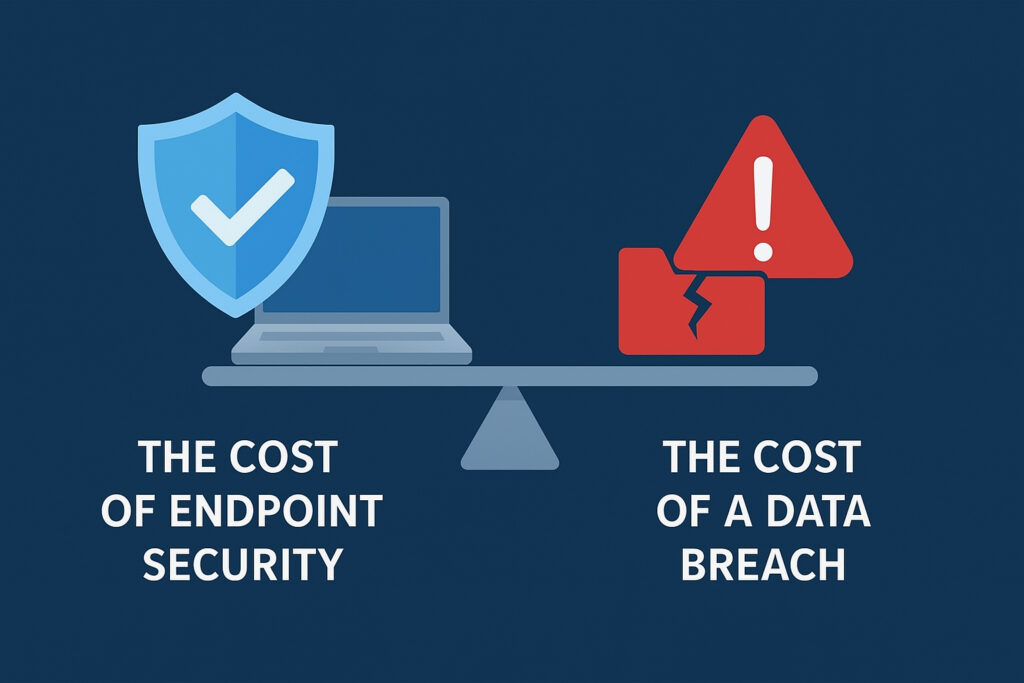
I’ve had this conversation more times than I can count. A business owner sits across from me, looking at endpoint security quotes, and says something like ”isn’t this a bit expensive?” And I get it. When you’re running a business, every expense needs justification. But here’s what usually happens next in our conversation—and it’s not pleasant.
We talk about what happens when one of their employees clicks the wrong link. Or when someone’s laptop gets stolen with customer data on it. Or when ransomware locks down their entire operation. Suddenly, that monthly security cost doesn’t look quite so expensive anymore.
What We’re Really Comparing
Let’s be honest about what endpoint security costs. For a typical small to medium business, you’re looking at somewhere between $5-15 per device per month. If you’ve got 20 employees with computers and phones, that’s maybe $200-600 monthly. Annually, we’re talking $2,400-7,200.
Now let’s talk about data breaches. According to IBM’s latest reports, the average cost of a data breach sits around $4.45 million. Even for small businesses, a breach typically costs at least $120,000-200,000 when you factor in everything that follows.
The math isn’t complicated, but people still hesitate. Why? Because endpoint security is a visible, recurring cost. A breach is theoretical—until it isn’t.
Breaking Down the Real Breach Costs
Here’s what actually happens when you get breached, based on what I’ve seen companies go through:
Immediate Response Costs: You need forensic investigators to figure out what happened. This alone can run $20,000-50,000. Then there’s legal consultation, IT remediation, and emergency security measures. You’re easily at $50,000-100,000 in the first week.
Notification and Compliance: Depending on where you operate, you might be legally required to notify affected customers. Those letters, call centers, and credit monitoring services? Another $50,000-150,000.
Lost Business: This is where it really hurts. Your systems are down. Employees can’t work. Customers can’t buy. I watched a small e-commerce company lose three weeks of their holiday season sales. That was $300,000 they never got back.
Reputation Damage: How do you quantify trust? One manufacturing company I know lost their biggest client after a breach. That was $2 million in annual revenue, gone.
The Hidden Costs Nobody Mentions
There’s stuff that doesn’t make the headlines but absolutely destroys businesses. Your insurance premiums shoot up—if your insurer doesn’t drop you entirely. Many companies now require proof of endpoint security before they’ll even talk to you about cyber insurance.
Employee productivity tanks for months. People spend weeks changing passwords, dealing with new security protocols, and frankly, just being stressed. Your IT team basically lives at the office for the first month post-breach.
And here’s something I learned the hard way: business partners get nervous. We had a client who lost two major contracts because their partners didn’t want to risk their own data by association. Nothing had actually happened to those partners, but the fear was enough.
What Endpoint Security Actually Prevents
Good endpoint security isn’t just antivirus anymore. We’re talking about real-time monitoring that catches suspicious behavior before it becomes a problem. When someone tries to access files they shouldn’t, or when a device starts communicating with a known malicious server, the system blocks it immediately.
Automatic updates are huge—most breaches happen through known vulnerabilities that should’ve been patched months ago. If your security solution handles this automatically, you’re closing doors before attackers even knock.
The thing is, most breaches aren’t sophisticated nation-state attacks. They’re opportunistic criminals using automated tools to find the easiest targets. It’s like home security—you don’t need to be Fort Knox, you just need to be harder to break into than the house next door.
The ROI Nobody Calculates
Here’s a simple way to think about it: If endpoint security costs $5,000 annually and prevents even one modest breach of $150,000, you’ve just saved 30 times your investment. Not 30 percent—30 times.
But the real ROI is what you don’t lose. Customer trust. Business continuity. Sleep at night. Your reputation in the market. The ability to tell partners and clients that yes, you take security seriously.
I’ve never met a business owner who regretted investing in endpoint security. I’ve met plenty who regretted not having it when they needed it.
Common Questions About the Investment
Can’t we just train employees better? Training is essential, but it’s not enough. Even security professionals occasionally click suspicious links. You need technical controls as backup.
What if we’re too small to be targeted? Attackers use automated tools that scan millions of devices. They don’t care about your size—they care about your vulnerabilities.
Isn’t basic antivirus sufficient? Basic antivirus is like locking your front door but leaving all your windows open. Modern threats need comprehensive protection.
The Bottom Line
Endpoint security isn’t an expense—it’s insurance that actually prevents the incident rather than just paying for it afterward. When you spend $200 monthly to protect your business, you’re not buying software. You’re buying continuity, trust, and peace of mind.
The question isn’t whether you can afford endpoint security. It’s whether you can afford not to have it.