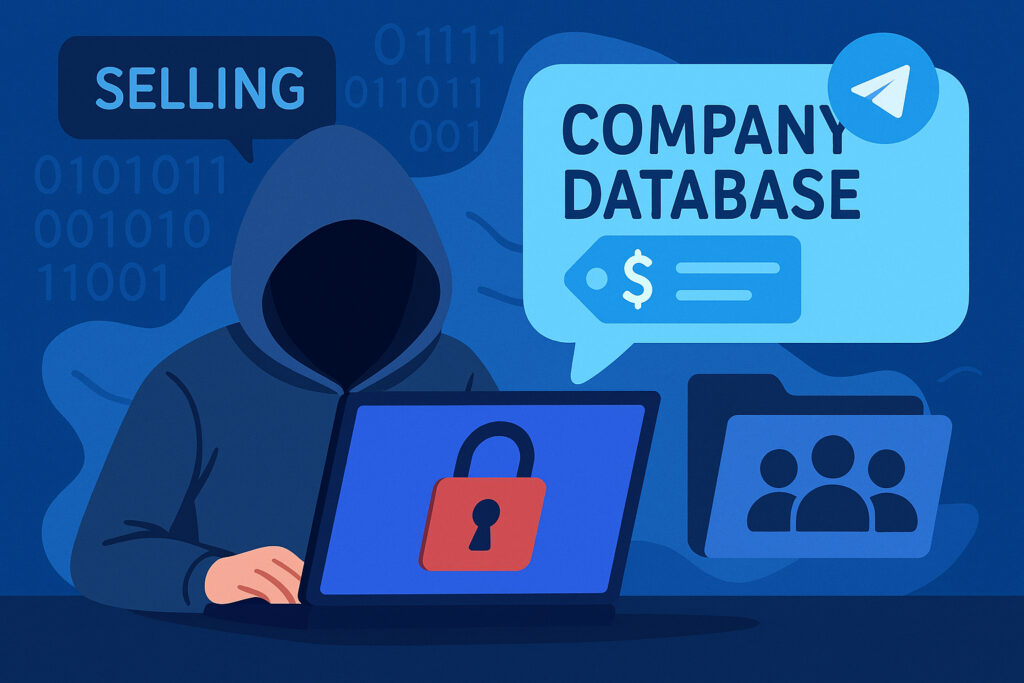
If you run a business or handle any kind of sensitive data, there is something you need to know about. Right now, on Telegram, there are thousands of channels openly selling access to stolen company databases. We are not talking about some hidden corner of the dark web that requires special software and crypto wizardry to reach. This is happening on an app that millions of people use every day to chat with friends and family. And the worst part? Most companies whose data is being traded have absolutely no idea it is happening.
I have spent years working in the cybersecurity monitoring space, and I can tell you that the shift toward Telegram as a marketplace for stolen data has been one of the most significant changes in the threat landscape over the past few years. Let me walk you through what is actually going on, why it matters, and what you can do about it.
How Telegram Became a Data Bazaar
Telegram has always marketed itself on privacy and minimal moderation. That is great for free speech, but it has also made the platform incredibly attractive to cybercriminals. After several dark web forums got shut down or became unreliable, sellers migrated to Telegram because it was easier, faster, and had a built-in audience of millions.
These channels operate almost like online shops. Some have price lists. Some offer ”samples” so buyers can verify the data is real before paying. Others run auction-style sales where the highest bidder gets exclusive access to a freshly stolen database. The level of professionalism is honestly disturbing. You will see channels with tens of thousands of subscribers, organized catalogs, and even customer support through private messages.
The types of data being sold range from employee login credentials and email archives to full customer databases with names, addresses, payment details, and national ID numbers. Some channels specialize in specific industries like healthcare, finance, or e-commerce. Others sell whatever comes their way.
A Real-World Example That Stuck With Me
A while back, while doing routine monitoring work, I stumbled across a Telegram channel advertising a database from a mid-sized European logistics company. The seller was offering around 400,000 customer records including shipping addresses, phone numbers, and partial payment data. The price was roughly 500 dollars. That is it. Half a thousand dollars for almost half a million people’s personal information.
What struck me was not just the price but the timing. The company in question had not disclosed any breach. There was nothing in the news, no notification to customers, nothing. Either they did not know yet, or they were still figuring out what had happened. Meanwhile, anyone with a Telegram account and some crypto could buy the data and start using it for phishing, identity theft, or worse.
This is not an isolated case. It happens every single day across hundreds of channels.
Why Traditional Security Measures Are Not Enough
A lot of companies still operate under the assumption that if they have a firewall, antivirus software, and maybe some employee training, they are covered. That might have been somewhat true ten years ago, but the reality today is very different.
The problem is that breaches often happen through third parties, supply chain attacks, or simple human error. An employee reuses a password. A vendor gets compromised. Someone accidentally pushes a database backup to a public repository. By the time your internal security team notices something is off, the data might already be circulating on Telegram.
There is also a common myth that only large corporations get targeted. That is simply not true. Smaller companies are often easier targets because they tend to have weaker security and fewer resources dedicated to monitoring. Criminals know this, and they exploit it.
What You Can Actually Do About It
The first step is accepting that prevention alone is not a complete strategy. You also need detection. You need to know as quickly as possible when your data shows up somewhere it should not be.
Start by identifying what your most sensitive data actually is. Customer databases, employee credentials, proprietary source code, internal communications, financial records. Know what you have so you know what to look for.
Next, set up some form of external monitoring. This means actively watching places where stolen data gets traded, including Telegram channels, dark web forums, paste sites, and code repositories. You can try to do this manually, but honestly, the volume is overwhelming. Automated monitoring tools are practically a necessity at this point. Services like LeakVigil exist specifically for this purpose. They continuously scan these sources and alert you when something matching your company’s data appears. The speed of detection matters enormously because the faster you know about a leak, the faster you can respond, reset credentials, notify affected parties, and limit the damage.
You should also enforce strong credential hygiene across your organization. Use unique passwords everywhere, enable multi-factor authentication, and rotate credentials regularly. Many of the databases being sold on Telegram are simply collections of reused passwords from older breaches that still work because nobody bothered to change them.
Finally, have an incident response plan ready. Do not wait until a breach happens to figure out who does what. Know in advance who gets notified, what gets shut down, and how you communicate with affected customers.
Common Questions People Ask
Can Telegram not just shut these channels down? They do sometimes, but new ones pop up almost immediately. It is a game of whack-a-mole, and the criminals are very good at adapting. Moderation has improved somewhat, but it is nowhere near enough to solve the problem.
Is it illegal to buy data from these channels? Yes, in virtually every jurisdiction, purchasing stolen data is illegal. But enforcement is extremely difficult, especially when buyers and sellers operate across borders and use cryptocurrency.
How do I know if my company’s data is already out there? Without active monitoring, you probably do not. That is exactly the problem. Most companies only find out about leaks when someone else tells them, sometimes months or even years after the data was first sold.
Are these databases always from direct hacks? No. A significant portion comes from credential stuffing, phishing campaigns, misconfigured cloud storage, or compromised third-party vendors. The source varies, but the end result is the same.
The Bottom Line
The underground market for stolen company data is not slowing down. If anything, the move to platforms like Telegram has made it more accessible and more dangerous than ever. The barrier to entry for cybercriminals has dropped dramatically, while the potential damage to businesses has only grown.
You cannot control whether someone tries to steal your data. But you can control how quickly you find out about it and how effectively you respond. Proactive monitoring is no longer optional. It is a basic part of doing business in a world where your customer database could be listed for sale right next to someone’s lunch order on the same messaging app.
Stay aware, stay monitored, and do not assume it cannot happen to you. Because statistically, it probably already has.