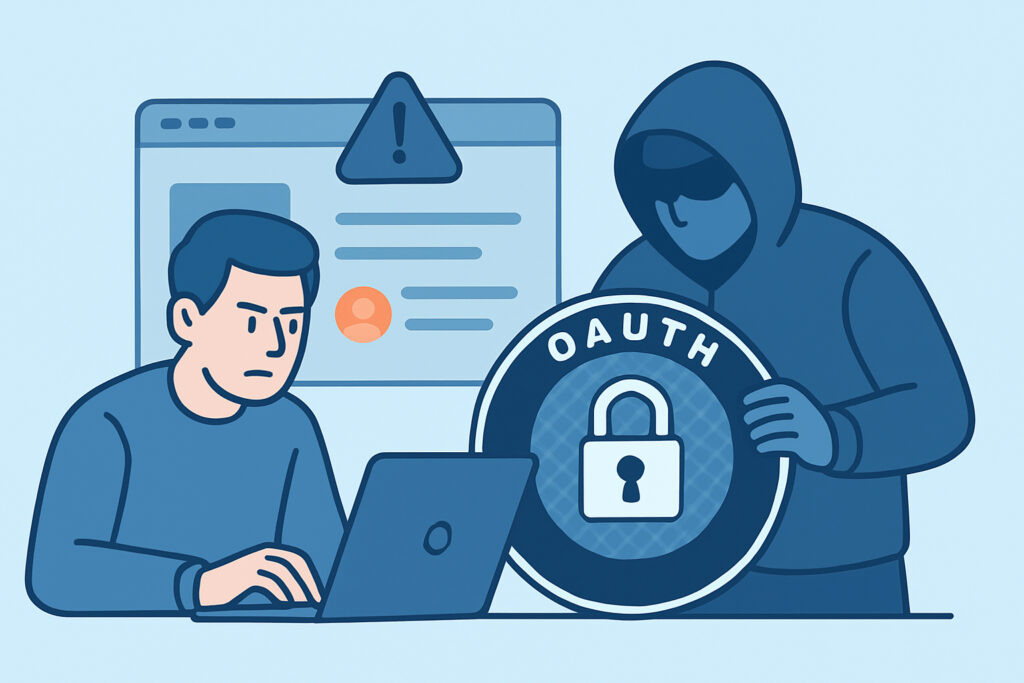
OAuth token leaks are one of the most underestimated account takeover vectors in enterprise security today. Unlike stolen passwords, leaked OAuth tokens bypass authentication entirely – no brute force needed, no MFA to defeat, just a valid token that grants direct API access to services your organization depends on.
Security teams that have spent years tightening password policies and deploying multi-factor authentication are often caught off guard when an attacker walks in through the front door with a legitimate-looking access token. The credentials look right, the session looks clean, and the audit log shows nothing unusual – at least at first.
What Sets OAuth Tokens Apart from Traditional Credentials
OAuth tokens are designed to delegate access without sharing passwords. They’re used everywhere: CI/CD pipelines connecting to GitHub, marketing tools talking to Google Analytics, customer support platforms pulling from Salesforce. Each integration generates tokens, and each token is a potential entry point.
The problem is scope. A leaked OAuth token doesn’t just expose one account – it exposes whatever permissions were granted at the time the token was issued. If a developer generated a token with broad repository access to speed up a project, that token leaked months later still carries those same permissions.
Tokens also have long lifespans. Refresh tokens can remain valid for months or even years unless explicitly revoked. Unlike passwords, they don’t expire automatically on a schedule most organizations control.
Where OAuth Tokens Surface After a Leak
The most common exposure path is source code repositories. Developers hardcode tokens into configuration files, commit them to GitHub, and either notice too late or not at all. API keys and OAuth tokens showing up in public repositories is a persistent problem that automated scanning alone hasn’t solved.
CI/CD logs are another overlooked channel. When a pipeline fails mid-run, error output often includes environment variables – including tokens that were passed as runtime parameters. Those logs may sit in a shared interface accessible to anyone with repository access.
Paste sites and dark web forums are where tokens end up after a breach. Attackers who extract tokens from compromised developer machines or server environments often post credential dumps that include OAuth tokens alongside passwords. The tricky part is that tokens don’t look like passwords – security teams scanning for email/password pairs can easily miss them.
Third-party SaaS breaches are also worth watching. When a vendor your organization uses suffers a breach, OAuth tokens your users granted to that platform can be included in the extracted data. You may have no warning until the token is used.
How Attackers Exploit Leaked OAuth Tokens
The attack flow is straightforward. An attacker finds a valid access token – from a GitHub search, a paste site, or a purchased credential dump – and sends a direct API request to the target service. The request succeeds. From there, the playbook depends on what the token can reach.
With a Google OAuth token, an attacker might enumerate Google Drive contents, download documents, or access Gmail. With a GitHub token, they can clone private repositories, modify code, or add webhooks that exfiltrate future commits. With a Slack token, they can read message history, download files, and impersonate bots.
Lateral movement after a credential leak often follows the same pattern – one valid token becomes a pivot point into connected systems, especially when the token belongs to an account with admin-level integrations.
The speed of exploitation is what makes OAuth token leaks particularly damaging. Some automated scanning tools check for freshly committed tokens within minutes of a public push. The window between exposure and exploitation can be under an hour.
The Myth That OAuth Is Inherently Safer Than Passwords
A common misconception is that OAuth is “more secure” than password-based authentication and therefore requires less monitoring. This confuses the security of the OAuth protocol with the security of the tokens it issues.
OAuth the protocol is well-designed. OAuth tokens in the wild are another matter. A token is a credential. It needs to be treated with the same sensitivity as a password – stored in secrets managers, rotated regularly, scoped narrowly, and monitored for exposure. The fact that it doesn’t look like a password is part of the risk, not a mark in its favor.
Organizations that have strong password hygiene but no token monitoring are operating with a significant blind spot. Attackers know this, and they target token leaks precisely because defenses around them tend to be weaker.
Detecting OAuth Token Leaks Across Sources
Effective detection requires monitoring multiple channels simultaneously. A token can surface on GitHub, in a paste site, in a dark web forum dump, or in a Telegram channel – often within the same 24-hour window after a breach. Checking one source while ignoring others leaves gaps that attackers exploit.
Credential stuffing attacks increasingly target OAuth tokens as well as passwords, which means token leak detection is becoming part of broader breach monitoring workflows rather than a separate specialty.
Pattern-based detection is also necessary. OAuth tokens for major platforms follow recognizable formats – GitHub personal access tokens have a specific prefix, Google OAuth tokens have predictable structures. Scanning for these patterns across repositories, logs, and public data sources can catch leaks that keyword-only monitoring misses.
Response time matters enormously. A token detected within minutes of exposure can be revoked before it’s used. A token discovered days later has likely already been exploited.
Immediate Steps When You Detect a Leaked OAuth Token
First, revoke the token immediately through the platform’s developer console or API. Don’t wait to investigate – revocation takes seconds and stops active exploitation.
Second, audit the token’s usage history. Most platforms maintain access logs. Look for API calls you don’t recognize, especially those originating from unexpected IP addresses or at unusual times.
Third, assess the token’s scope. Determine what resources the token could access and treat those resources as potentially compromised. Notify relevant teams if customer data, source code, or infrastructure configuration was within reach.
Fourth, rotate any dependent credentials. If the leaked token was used to access a system that stores other secrets, rotate those secrets as well. Token leaks often reveal the entry point for a broader compromise.
Finally, review how the token was generated and stored in the first place. Hardcoded tokens are a process problem, not just a one-time incident. Implement pre-commit hooks or secrets scanning to catch future cases before they reach a repository.
Frequently Asked Questions
Can an OAuth token leak happen even if we use short-lived tokens?
Yes. Short-lived access tokens reduce the exploitation window, but they’re often paired with long-lived refresh tokens that can be used to generate new access tokens indefinitely. If a refresh token leaks, the attacker can maintain persistent access long after the initial access token would have expired. Monitoring needs to cover refresh tokens, not just access tokens.
How do we know if an OAuth token has already been used by an attacker?
Check the platform’s API access logs and OAuth application audit logs for the period after the token was created. Look for requests from unfamiliar IP ranges, unusual geographic locations, high request volumes at off-hours, or access to resources the legitimate user wouldn’t normally reach. Some platforms send anomalous login notifications automatically; others require manual review.
Is it enough to scan our own repositories for leaked tokens?
No. Tokens can leak through third-party services, developer machines, CI/CD environments, and vendors your organization uses. Comprehensive sensitive data exposure monitoring needs to cover public repositories, paste sites, dark web sources, and breach databases – not just your own code. Internal scanning catches what you accidentally publish; external monitoring catches what escapes through other paths.
Summary
OAuth token leaks are a quiet but high-impact account takeover vector that often bypasses the security controls organizations invest most heavily in. Tokens live longer than passwords, carry broader permissions, and are routinely mishandled in ways that expose them to external monitoring. Detection requires watching multiple data sources in real time – because by the time a leaked token appears in a credential dump, the window for easy containment is already closing. Treat every OAuth token as a credential, monitor for its exposure, and have a revocation procedure that can execute in minutes, not hours.