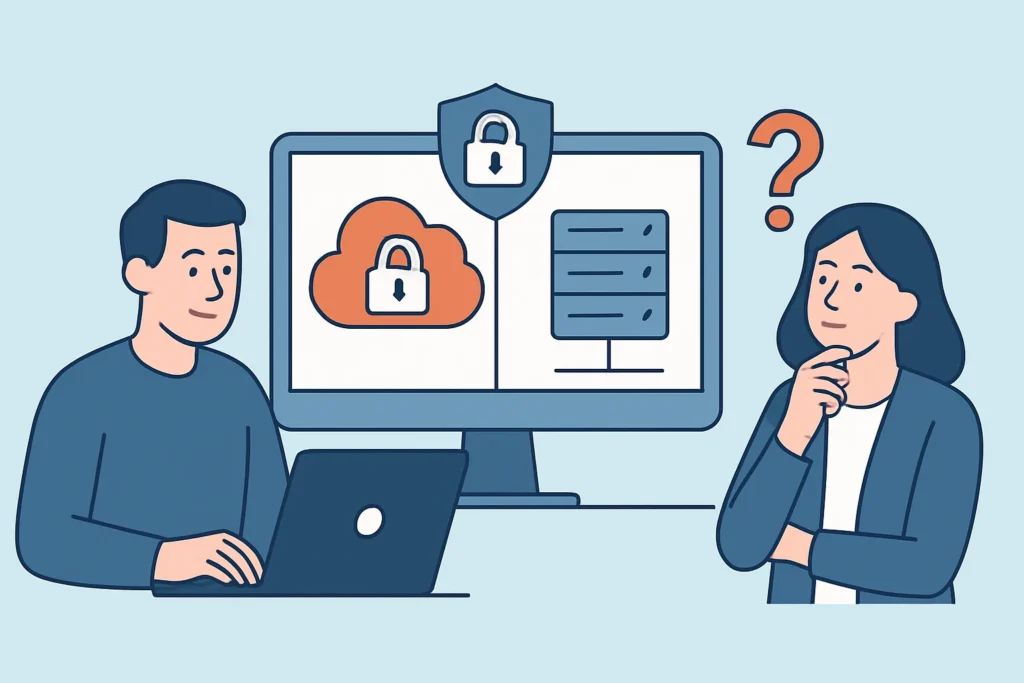
Security teams comparing managed vs self-hosted leak monitoring usually start asking the question after a scare: a credential dump that surfaced weeks too late, or a board member asking who actually watches criminal forums for the company. This article covers what each service model really includes, what it costs beyond the license line, where each one tends to fail, and how to choose based on team size, regulation and how much maintenance you can take on.
Both models can work. The wrong choice rarely fails loudly. It fails quietly, with a dashboard that keeps showing zero alerts.
What Each Service Model Actually Includes
A managed service runs the collection infrastructure for you. That means crawlers for paste sites, Telegram channels, Tor marketplaces and code repositories, plus ingestion of breach datasets, normalization, matching against your watchlist and alert delivery. You supply domains, keywords, executive names and IP ranges. The provider handles source access, scraper upkeep and usually some first-pass triage.
A self-hosted setup is something your team assembles and runs. A typical stack combines Gitleaks or TruffleHog for repository scanning, the Have I Been Pwned domain search API for breach exposure, SpiderFoot or IntelOwl for OSINT enrichment, and MISP or OpenCTI to store and correlate indicators. Custom glue code ties it together, often along the lines of the approaches described in Python scripts for custom data leak monitoring workflows.
The difference isn’t about software. It’s about who is responsible when a source changes, a forum moves domains or an API key expires.
The Hidden Cost of Running It Yourself
Self-hosted tooling looks cheap because most of the components are open source. The real cost is engineering time. A rough estimate for a reasonably broad pipeline is 8-15 hours per week of maintenance once it’s stable, and more during the first three months. With a fully loaded security engineer costing $120,000-180,000 a year in the US, that time alone is often worth $25,000-60,000 annually.
Here’s a scenario many mid-sized companies will recognize. A 300-person SaaS company has an engineer build a Python pipeline: Gitleaks on the GitHub organization, HIBP domain checks, and scrapers for a handful of Telegram channels where stealer logs circulate. It works well for six months. Then the engineer changes teams. Two of the channels get banned and reappear under new handles, and the scraper keeps running, returning nothing. Eleven weeks pass before anyone notices, because zero alerts looked like good news.
That silent failure is the main risk of self-hosting. An experienced detection engineer instruments the pipeline itself and treats “no results from source X for 72 hours” as an alert, not a quiet day.
Managed services have their own hidden costs. Pricing usually scales with monitored assets, so a company with 40 domains and 2,000 employee email addresses can see quotes rise sharply. Alert volume also needs tuning. Without it, analysts drown in old combolist entries, a problem covered in more depth in tuning false positives in leak alerts.
Myth: Self-Hosted Means Your Data Never Leaves the Building
This is the most common justification for building in-house, and it’s mostly wrong. Leak monitoring is about external sources by definition. To check whether your data has appeared somewhere, you have to query that somewhere.
Each HIBP lookup, Intelligence X search, Shodan query or search engine dork sends part of your watchlist to a third party. Your scrapers connect to criminal infrastructure from IP addresses that may trace back to your organization. A self-hosted stack spreads your sensitive search terms across a dozen providers instead of one, and usually with less contractual protection.
The privacy question is real. It just needs to be asked of every data flow, not only of the vendor. With a managed provider, ask where watchlists are stored, whether EU data residency is available for GDPR and NIS2 purposes, and who can see your matches.
Where the Standard Advice Breaks Down
“Small teams should buy, large teams can build” holds most of the time, but not always.
Defense contractors working under ITAR, and organizations handling classified material, sometimes can’t share asset lists with any outside party. For them, self-hosting the correlation layer is a requirement even if collection still has to touch the internet. Air-gapped environments can’t do external monitoring at all from inside the network. They need a separate, isolated collection segment.
Teams with fewer than 10 people in IT should almost never self-host the full pipeline. Nobody will own it after the first person who built it gets busy.
Language coverage is often overlooked. If your exposure sits on Russian-language forums or Chinese marketplaces, a self-hosted pipeline is only as useful as the person reading the output. Many managed providers have native-speaking analysts, and that is difficult to build internally.
The most practical answer is often hybrid. Buy managed coverage for external sources such as dark web markets, Telegram and breach datasets, where upkeep is heavy. Self-host what is close to your own infrastructure, such as secret scanning in CI, canary tokens and internal repository monitoring.
A Five-Step Decision Process for Managed and Self-Hosted Leak Monitoring
A seasoned security lead goes through roughly this sequence before committing budget:
1. List the sources you actually need covered, then mark which ones need authenticated or invite-only access.
2. Estimate maintenance hours per source per month, and name the person who will own each one.
3. Map every data flow your watchlist would pass through under each model, including third-party APIs.
4. Check regulatory constraints, such as NIS2 incident reporting duties, sector rules and data residency.
5. Run a 30-day pilot of both options against the same watchlist and compare true positives, not total alerts.
The pilot step settles most debates. Numbers from your own environment carry more weight than any vendor deck or internal enthusiasm. For the cost side, see building a budget for continuous data leak monitoring.
Common Mistakes That Undermine Either Model
Measuring alert count instead of time to detection. A system producing 400 alerts a month isn’t better than one producing 12. What matters is how quickly real exposure of leaked credentials, exposed data or source code reaches someone who can act on it.
Treating setup as the finish line. Self-hosted stacks decay as sources move. Managed watchlists go stale too. New domains from acquisitions, rebranded products and new executives often never get added, so whole parts of the attack surface go unmonitored.
Skipping the response path. Detection without a playbook only produces anxiety. Before choosing a model, decide who rotates credentials, who contacts legal and who handles breach notification. A managed alert at 2 a.m. is worth nothing if it goes to a shared inbox nobody reads until Monday.
FAQ
Is self-hosted leak monitoring cheaper than a managed service?
Rarely, once engineering time is counted. Open-source tools cost nothing to license, but maintaining scrapers, API integrations and threat intelligence correlation typically takes 8-15 hours a week. For most organizations under 1,000 employees, that time costs more than a managed subscription.
Can a managed service cover internal sources like our private repositories?
Some can, through API integrations with GitHub, GitLab or Bitbucket. Many teams still keep internal secret scanning self-hosted in CI pipelines with Gitleaks or TruffleHog, because those checks belong in the development workflow anyway.
How do we evaluate a managed provider’s source coverage?
Give them a test set: an email address from a known older breach, a seeded canary token and a few historical leaks you already know about. Then see what they find, how fast, and with how much context.
Summary
Managed monitoring trades control for coverage and lower maintenance. Self-hosting trades engineering hours for flexibility and tighter control of the correlation layer. Neither keeps your search terms entirely private, and either one can fail silently if nobody watches whether the system itself is still working.
Whichever model you choose, add one check this week: an alert that fires when any source returns no data for three days. It costs an hour to build and catches the failure that causes the most damage.