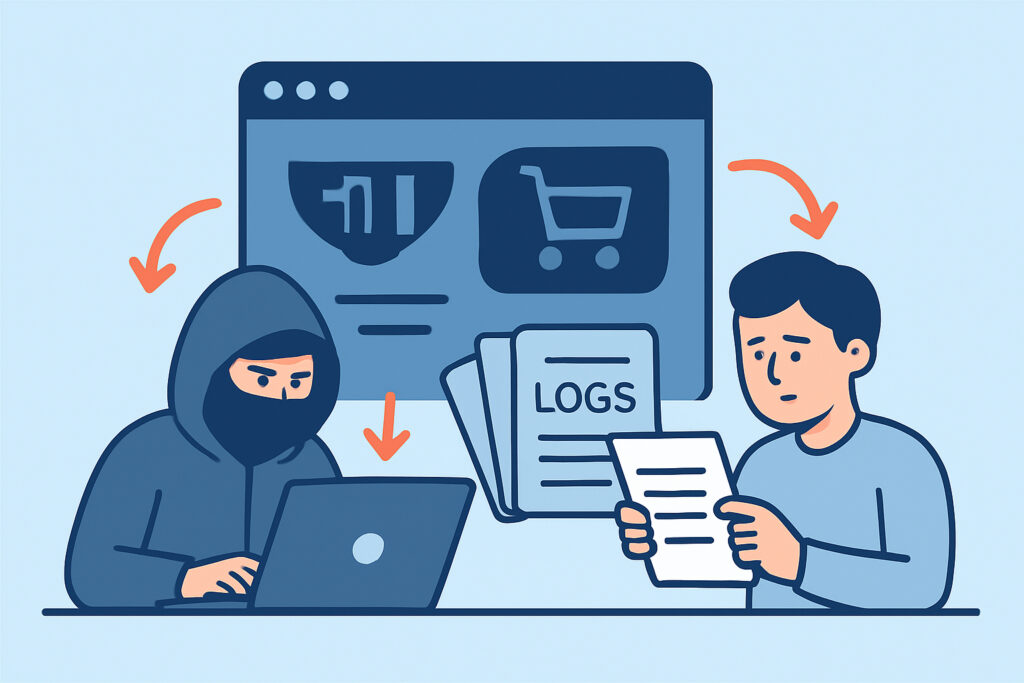
Every morning, millions of freshly stolen credential sets land on criminal marketplaces before most security teams have finished their coffee. Stealer logs — the raw output of information-stealing malware — have become the fastest-growing category of stolen data circulating online, and understanding how they move from an infected laptop to a searchable marketplace listing is essential for anyone responsible for protecting corporate credentials.
What exactly is a stealer log
A stealer log is the packaged output of malware like RedLine, Raccoon, Vidar, or Lumma – families built specifically to harvest everything of value from an infected machine in one pass. A single log typically contains saved browser passwords, autofill data, session cookies, cryptocurrency wallet files, and a system fingerprint (OS version, installed software, IP address, sometimes even a screenshot).
Unlike a traditional data breach, which exposes one company’s database, a stealer log exposes everything on one person’s device – personal accounts, banking logins, and whatever corporate systems that person happened to be signed into when the malware ran. That’s what makes logs so dangerous for businesses: an employee’s infected home laptop can hand over VPN sessions, SSO cookies, and SaaS admin panels in a single file, even if the company itself was never directly attacked.
Why the volume has exploded
Stealer malware is cheap, disposable, and sold as a service. Malware-as-a-service operators rent access to builders for as little as $100–$200 a month, and affiliates distribute the payload through cracked software, fake installers, malicious ads, and phishing attachments. Infection is largely automated, and so is exfiltration – logs are uploaded to a Telegram bot or C2 panel the moment the malware finishes running.
That automation is the real driver of scale. Where a manual breach might take weeks of reconnaissance, a stealer campaign can infect thousands of machines in days with zero human interaction after deployment. Researchers tracking public and semi-public stealer channels routinely observe tens of thousands of new logs posted in a single day across just the largest distribution channels – a volume that dwarfs what traditional breach dumps produce, because it’s continuous rather than a one-time event tied to a single incident.
From infection to marketplace listing
The path a stolen log takes is fairly consistent, and knowing it helps explain why detection speed matters so much.
1. Malware executes on the victim device, usually delivered through a trojanized download, malicious ad, or phishing lure.
2. The stealer harvests browser-stored credentials, cookies, and autofill data, then compresses it into an archive.
3. The archive is exfiltrated automatically to a Telegram channel, a private cloud panel, or directly to a log-selling marketplace.
4. Free or low-cost “cloud of logs” services index the raw archive, making it searchable by domain, email, or country.
5. Brokers filter for high-value entries – corporate email domains, banking portals, admin panels – and repackage them for sale or bundle them into combolists, described in more detail in this breakdown of how combolists are built.
6. Buyers use the credentials for account takeover, initial access sales to ransomware affiliates, or further phishing.
The entire cycle, from infection to a searchable listing, can complete in under 24 hours. That’s a meaningfully different threat model than a breach disclosure, where companies often have days or weeks of lead time before stolen data actually surfaces for sale.
Where the logs actually end up
Not all stealer output goes to the same place. Free logs – often older or lower-value – get dumped into public Telegram channels as advertising for a paid tier. Curated, higher-value logs move to dedicated forum marketplaces where stolen data gets sold first, often with search functionality that lets a buyer filter by target company domain before purchasing. This is the mechanism behind a specific and underappreciated risk: a criminal can search “@yourcompany.com” across recent log uploads and get a list of every employee whose personal device was compromised, complete with any corporate session cookies that were active at the time.
A common misconception worth correcting
A persistent myth is that stealer logs only matter if an employee reused a corporate password on a personal site. In reality, the bigger risk is session cookie theft, not password reuse. If an active session cookie for a corporate SSO, VPN portal, or SaaS admin console is sitting in that log, an attacker can often walk straight past MFA entirely – no password guessing required, no login prompt triggered. Password rotation alone doesn’t fix this; sessions need to be invalidated too. The mechanics of this bypass are covered in depth in a look at session cookie theft as a credential leak without passwords.
What actually reduces exposure
Blocking every stealer infection outright isn’t realistic – phishing and malicious ads are too varied, and personal devices sit outside most corporate controls entirely. What is realistic is shortening the window between infection and detection. Enforcing short session lifetimes, requiring re-authentication for sensitive actions, and monitoring for corporate domains appearing in freshly indexed logs all cut down the time an attacker has to act on stolen access. Because logs typically stay valuable to buyers for a limited period before credentials get rotated or accounts get flagged, that window is where the damage does or doesn’t happen – more on how long stolen data actually stays useful can be found in this analysis of how long stolen data stays fresh on criminal markets.
Frequently asked questions
How many stealer logs are posted online each day?
Estimates vary by tracker and channel, but large public and semi-public distribution points regularly show tens of thousands of new log uploads daily, with volume trending upward year over year as malware-as-a-service lowers the barrier to entry for attackers.
Can a company be affected by stealer logs even if it was never directly hacked?
Yes. If an employee’s personal device gets infected while a corporate session was active in the browser, that access can end up in a log and later for sale – with no breach of company infrastructure required.
Does changing passwords stop the risk from a stealer log?
It helps, but it’s not sufficient on its own. Active session cookies and browser-stored tokens captured before rotation can remain valid until they’re explicitly revoked, which is why session invalidation matters as much as password resets.
Stealer logs are less a single incident to respond to than a constant, low-grade drip that adds up fast. Treating credential exposure as an ongoing monitoring problem – rather than a one-time cleanup after a breach headline – is what actually keeps pace with how quickly this data moves.