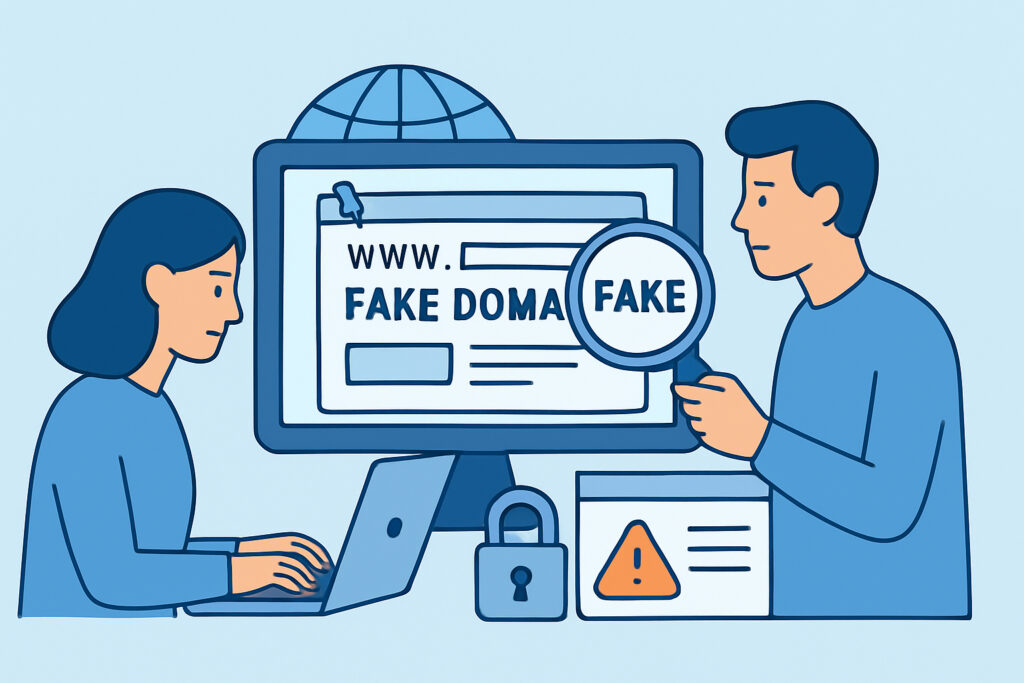
Brand abuse monitoring has become a core requirement for any organization that takes its online reputation and customer security seriously. When threat actors register lookalike domains or clone your website, the damage happens to your customers first – and to your brand second, often before your security team knows there’s a problem.
What Brand Abuse Actually Looks Like in Practice
The most common scenario plays out like this: a company launches a new product, runs a marketing campaign, and increases its web traffic. Within days – sometimes hours – a threat actor registers a domain like companyname-support[.]com or company-name[.]net and stands up a cloned version of the legitimate website. Customers who mistype the URL, click a phishing link, or find the fake site through search results hand over their credentials without suspecting anything.
This isn’t a rare edge case. It happens to companies of every size, in every sector. The attack is cheap to execute, hard to detect without active monitoring, and effective enough that it remains a staple of criminal playbooks.
How Fake Domains Are Registered and Why They Evade Detection
Attackers use several techniques to make lookalike domains convincing:
Typosquatting – registering domains with common misspellings or transposed characters.
Homoglyph attacks – replacing Latin letters with visually similar Unicode characters (rn instead of m, for instance).
Subdomain abuse – constructing URLs like yourcompany.attacker.com to trick users who only scan the beginning of an address.
TLD swaps – registering your brand under .net, .org, .co, .info, or newer gTLDs after you secured .com.
The registrations themselves are trivially easy. Domains cost a few dollars, WHOIS privacy services hide the registrant’s identity, and hosting can be spun up on shared infrastructure within minutes. By the time a takedown request is processed, a campaign has often already run its course.
Typosquatting campaigns built around fake domains are particularly dangerous because they exploit human error rather than a technical vulnerability – no patch exists for a user who misreads a URL.
Cloned Sites: The Technical Mechanics
Registering a domain is only step one. The next step is making the fake site look identical to the real one. Attackers use automated tools to mirror the HTML, CSS, images, and page structure of legitimate websites. Some clones pass a careful visual inspection.
What separates a convincing clone from a crude fake: a valid TLS certificate (Let’s Encrypt makes this free and instant), accurate reproduction of login flows and error messages, and functional forms that harvest credentials and then redirect users to the real site. That last detail is the most dangerous – a user who enters their password and is then redirected to a “session expired” page on the legitimate site will simply log in again, attributing the confusion to a browser glitch.
The Myth That Only Large Brands Get Targeted
There’s a persistent assumption that brand abuse is a problem for banks, airlines, and Fortune 500 companies. In practice, mid-size companies and regional businesses are targeted regularly. Criminal operators don’t manually select victims – they run automated scans across thousands of domains, register lookalikes in bulk, and deploy phishing infrastructure at scale.
If your organization runs e-commerce, handles customer logins, manages sensitive data, or has any recognizable web presence, you’re a viable target. The investment required to abuse your brand is minimal. The potential return – harvested credentials, payment card data, or material for executive impersonation and BEC fraud – is significant enough to justify the effort many times over.
Building an Effective Brand Abuse Monitoring Strategy
Detection speed is everything. A fake domain that runs undetected for two weeks can compromise thousands of users. A structured monitoring approach reduces that window dramatically.
Step 1 – Define your monitoring scope. List all legitimate domains your organization controls, brand names, product names, and distinctive terms. These become your watchlist.
Step 2 – Monitor new domain registrations. Certificate transparency logs and domain registration feeds surface newly registered lookalike domains in near real time. A domain registered today could be live by tomorrow morning.
Step 3 – Check for content clones. Domain registration alone doesn’t tell you if a fake site is active. Regular scans for content that mirrors your login pages or brand assets catch campaigns using pre-existing domains rather than freshly registered ones.
Step 4 – Watch underground channels. Threat actors sometimes announce phishing kit deployments in criminal forums before launching campaigns. Detecting these early provides a head start on takedowns.
Step 5 – Establish takedown procedures in advance. Know your registrar abuse contacts, hosting provider abuse procedures, and ICANN’s Uniform Domain-Name Dispute-Resolution Policy (UDRP) before you need them. A takedown that takes two weeks is far less useful than one completed in 48 hours.
The Downstream Consequences of Late Detection
The effects extend well beyond the initial credential harvest. Customers who were phished through a fake version of your site may never connect the incident to the legitimate company – but they’ll associate the bad experience with your brand. Support volume spikes, trust erodes, and in regulated industries the reputational damage can draw regulatory attention.
Stolen credentials gathered through cloned login pages also fuel lateral movement after a credential leak – once an attacker holds a valid set of corporate credentials, the options for network intrusion multiply quickly. Security teams that discover brand abuse weeks or months after a campaign ended face a particularly difficult investigation: there’s no clean moment of compromise, no single system to isolate, and often no clear count of affected users.
FAQ
How quickly can a fake domain campaign cause damage?
An attacker can register a lookalike domain, deploy a cloned site, and begin sending phishing emails within a few hours. Credential harvesting can start the same day the campaign goes live. This is why monitoring for new domain registrations in real time matters – a 24-hour detection lag can translate to hundreds of compromised accounts before any alert is triggered.
Can I rely on browser security warnings to protect my users?
No. Modern phishing sites routinely obtain valid TLS certificates through free issuers like Let’s Encrypt, so the padlock icon appears in the browser address bar. Browsers display warnings for invalid certificates, not for lookalike domains that carry valid ones. Users who have been trained to “look for the padlock” are not meaningfully protected against well-constructed cloned sites.
What’s the difference between brand monitoring and brand abuse monitoring?
Brand monitoring typically tracks mentions of your company name across news, social media, and review platforms – it’s primarily a reputation management function. Brand abuse monitoring is a security discipline focused on detecting fake domains, cloned websites, and unauthorized use of brand assets in phishing infrastructure. The two practices overlap but serve distinct purposes and require different tooling.
Key Takeaways
Brand abuse through fake domains and cloned sites is a persistent, low-cost attack vector that organizations in every sector face. The combination of cheap domain registration, automated site cloning tools, and free TLS certificates means a convincing fake version of your website can be operational before your customers – or your security team – ever notices. Monitoring new domain registrations, certificate transparency logs, and underground forum activity provides the detection window needed to act before campaigns run their full course. The goal isn’t to prevent registrations entirely – that isn’t achievable – but to detect them fast enough that takedowns happen in hours rather than weeks.