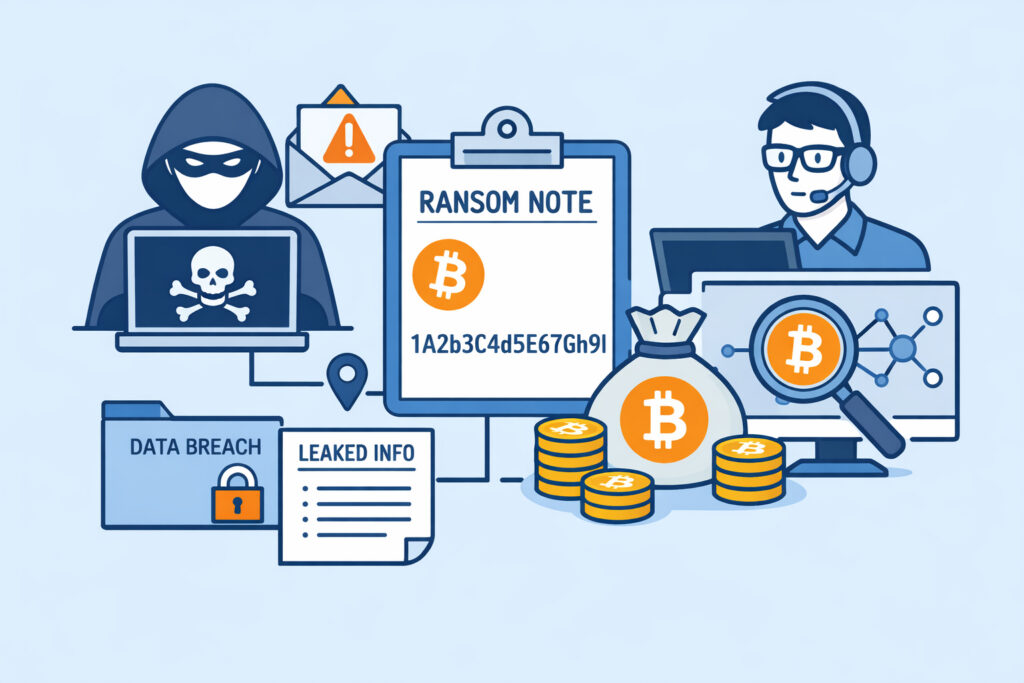
If your organization has received a ransom demand with a Bitcoin address – or you’ve spotted one tied to your company’s data on a dark web forum – you’re dealing with more than just a payment request. Bitcoin addresses in ransom demands are traceable breadcrumbs that can reveal the scope of a breach, connect separate incidents, and even help law enforcement build cases against threat actors. Understanding how to track and analyze these addresses gives security teams a powerful tool for assessing the true impact of a data breach.
This article walks you through how Bitcoin addresses function in extortion campaigns, why they matter for breach analysis, and what your team can do with them right now.
Why Attackers Use Bitcoin – and Why That’s Actually Useful
Ransomware operators and extortionists favor Bitcoin because it’s pseudonymous, fast, and doesn’t require a bank. But pseudonymous is not anonymous. Every Bitcoin transaction is recorded on a public blockchain – permanently. That means the address in your ransom note is a starting point for investigation, not a dead end.
Here’s what most people get wrong: they assume cryptocurrency payments disappear into a black hole. In reality, blockchain analytics firms and law enforcement agencies have recovered millions in ransom payments by following the money trail. The Colonial Pipeline recovery in 2021 – where the FBI clawed back roughly 63.7 Bitcoin – is probably the most well-known example, but it’s far from the only one.
For your security team, a Bitcoin address is an intelligence artifact. Treat it like an IP address or a malware hash – something you can pivot on to uncover connections.
How Bitcoin Addresses Reveal Breach Scope
When you receive a ransom demand, the Bitcoin address attached to it can tell you several things if you know where to look.
Linking multiple victims. Threat actors frequently reuse wallet addresses or cycle funds through a small cluster of wallets. If the same address appears in ransom demands sent to other organizations, that’s a signal you’re dealing with a campaign, not a one-off attack. Blockchain explorers like Blockchair or OXT let you check transaction histories and see how funds move.
Estimating the attacker’s revenue. By examining incoming transactions to a ransom wallet, you can gauge how many victims have paid. If you see dozens of deposits in similar amounts over a short period, you know the threat actor is running a large-scale operation – which usually means they’re monetizing stolen credentials across many targets simultaneously.
Mapping the cash-out chain. Attackers eventually move Bitcoin to exchanges or mixing services to convert it to fiat currency. Tracing that chain – even partially – can reveal geographic indicators, preferred exchanges, and operational patterns. This is intelligence your incident response team and legal counsel can act on.
Connecting to known threat groups. Threat intelligence platforms maintain databases of wallet addresses tied to specific ransomware families and APT groups. A quick lookup can tell you whether you’re dealing with LockBit, BlackCat, or a less sophisticated operator – which directly affects your response strategy.
Practical Steps for Your Security Team
You don’t need a blockchain forensics certification to start extracting value from a Bitcoin address. Here’s a straightforward process.
Step 1: Preserve the evidence. Screenshot the ransom note. Record the Bitcoin address, the demanded amount, any deadlines, and the communication channel. Hash the ransom note file. Store everything in your case management system before you do anything else.
Step 2: Check the address against public databases. Use free tools like Blockchair, Blockchain.com, or BitcoinAbuse.com to look up the wallet. You’re checking for transaction history, reported abuse, and any tags linking the address to known campaigns.
Step 3: Assess transaction patterns. Look at when the wallet was first active, how many transactions it’s received, and the total volume. A wallet that’s received 50 payments of similar amounts in the past month tells a very different story than a freshly created one with zero history.
Step 4: Report the address. File reports with your national CERT, law enforcement, and platforms like BitcoinAbuse. This feeds the collective intelligence that helps everyone – and it’s often a legal requirement depending on your jurisdiction.
Step 5: Feed findings into your incident response. The wallet analysis should inform your incident response playbook. If the address is linked to a known group, you can anticipate their tactics – do they typically exfiltrate data before encrypting? Do they publish on specific leak sites? This shapes your containment and communication strategy.
The Myth of Untraceable Crypto
One persistent misconception is that paying a ransom in Bitcoin means the money is gone forever and can’t be traced. This hasn’t been true for years. Blockchain analysis tools from companies like Chainalysis and Elliptic have become standard in law enforcement investigations. Even when attackers use mixing services or chain-hop through multiple cryptocurrencies, analysts can often follow the trail.
That said, tracing doesn’t always mean recovery. The practical reality is that getting funds back depends on speed, jurisdiction, and whether exchanges cooperate. But from a breach impact perspective, the tracing itself is valuable – it tells you who you’re dealing with and how wide the campaign extends.
Connecting Wallet Intelligence to Breach Monitoring
Bitcoin address tracking becomes significantly more powerful when combined with dark web monitoring. If LeakVigil detects your organization’s data on a paste site or hacker forum, and you can cross-reference the associated wallet addresses with ones from your ransom demand, you’ve just confirmed a direct link between the extortion attempt and the actual data exposure.
This kind of correlation is what separates a panicked reaction from an informed response. Instead of guessing whether the attacker actually has your data, you have evidence. That evidence drives better decisions about whether to engage, how to communicate with regulators, and how to estimate the real cost of the breach beyond immediate remediation.
FAQ
Can tracking a Bitcoin address actually help recover ransom payments?
In some cases, yes. Law enforcement has successfully seized funds by working with exchanges where attackers attempted to cash out. Speed matters – reporting the address quickly increases the chances. However, recovery is not guaranteed and depends heavily on the attacker’s sophistication and jurisdictional cooperation.
Should we pay the ransom if we can track the Bitcoin address?
Tracking capability doesn’t change the fundamental advice: paying is generally discouraged. It funds criminal operations and doesn’t guarantee data recovery or deletion. However, the decision is complex and should involve legal counsel, law enforcement, and your leadership. What tracking does give you is better intelligence to inform that decision.
Is it legal to use blockchain analysis tools on a ransom Bitcoin address?
Yes. Bitcoin’s blockchain is public by design. Analyzing publicly available transaction data is legal in virtually all jurisdictions. Many commercial and free tools exist specifically for this purpose, and law enforcement actively encourages organizations to report and analyze ransom wallet addresses.
Ransom demands are stressful, but the Bitcoin addresses they contain are one of the few advantages defenders have. Treat every wallet address as an intelligence lead – document it, analyze it, share it with the right parties, and let it guide your response. The attackers chose Bitcoin for convenience. Use that same transparency against them.