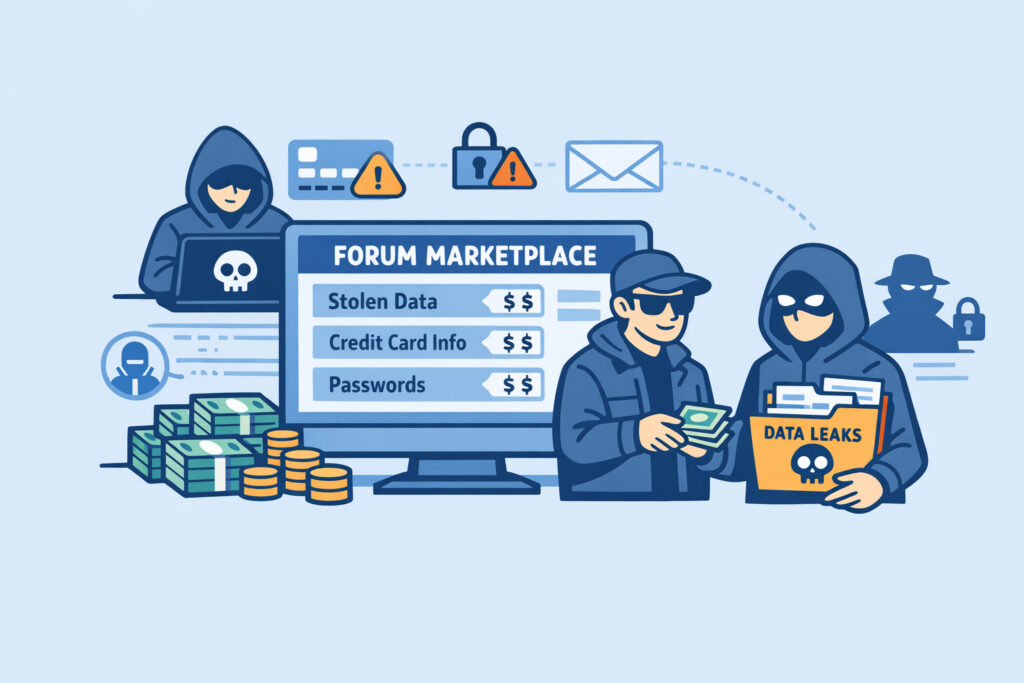
If you’re responsible for your organization’s security, you need to understand where stolen data actually ends up before it spreads. Forum marketplaces – underground communities where cybercriminals buy, sell, and trade compromised data – are often the first stop after a breach. Knowing how these forums operate gives you a critical head start in detecting exposures and limiting damage.
Most security teams focus on preventing breaches but spend far less time thinking about what happens in the hours and days after data is stolen. That gap is exactly what attackers exploit.
What Are Forum Marketplaces and Why They Matter
Forum marketplaces are structured online communities – often hosted on the dark web, but sometimes on the clearnet – where threat actors post stolen databases, credential dumps, access tokens, and corporate documents for sale. Think of them as classified ad boards for stolen data, complete with seller reputations, escrow systems, and even customer support.
These aren’t chaotic chat rooms. The most established forums have strict rules, vetting processes for new members, and tiered access levels. Sellers build credibility over time, and buyers leave feedback. Some forums specialize in specific verticals – financial data, healthcare records, corporate VPN credentials – while others are general-purpose bazaars.
What makes forum marketplaces especially dangerous is speed. A database stolen on Monday can be listed for sale by Tuesday morning. In many cases, data appears on these forums weeks or months before it shows up in mainstream breach notification databases. If you’re only relying on services like Have I Been Pwned to learn about exposures, you’re already late.
How Stolen Data Moves Through Forum Marketplaces
Here’s a typical timeline that security teams rarely see from the inside:
Day 0–1: An attacker exfiltrates a database – say, 200,000 customer records from an e-commerce platform. They verify the data quality, check for duplicates, and package it.
Day 1–3: The attacker posts a sample (usually 1–5% of the dataset) on a forum marketplace as proof. The listing includes a description of the data fields, the source industry, estimated record count, and a price – often ranging from a few hundred to tens of thousands of dollars depending on freshness and content.
Day 3–7: Interested buyers negotiate. Some forums use auction-style bidding; others have fixed prices. Exclusive sales (where only one buyer gets the data) command a premium. Non-exclusive dumps are cheaper but spread faster.
Day 7–30: If the data doesn’t sell exclusively, it often gets reposted, shared in smaller pieces, or leaked for free to build the seller’s reputation. At this point, the data starts appearing on paste sites, Telegram channels, and secondary forums.
Day 30+: The data enters the broader ecosystem. Credential stuffing lists get compiled. Phishing campaigns targeting the breached users begin. Eventually, breach notification services pick it up.
The takeaway: the window between theft and widespread exposure is narrow, and most organizations don’t even know they’ve been hit until the data is already circulating freely.
The Myth That Only Big Companies Get Targeted
One of the most persistent misconceptions is that forum marketplaces primarily deal in data from large enterprises – the mega-breaches that make headlines. In reality, small and mid-sized business data is extremely common on these forums.
Why? Because attackers know that smaller organizations typically have weaker monitoring and slower incident response. A database of 10,000 records from a regional accounting firm might not make the news, but it’s still valuable. It contains real names, email addresses, tax identifiers, and sometimes financial details. Sellers on forums price these smaller dumps affordably – sometimes as low as $50–$200 – which makes them accessible to a wide range of buyers, including automated credential stuffing operators.
I’ve seen forum listings where a seller had dozens of small-business databases bundled together, sold as a package deal. No single breach was newsworthy, but together they represented hundreds of thousands of compromised individuals.
What Gets Sold and How It’s Priced
Forum marketplace listings typically include several categories of stolen data:
Credential dumps – email and password combinations, often from phishing campaigns or infostealer malware. Fresh credentials (less than 30 days old) with verified login success rates sell for $10–$50 per thousand records. Understanding how cybercriminals monetize stolen corporate credentials helps security teams anticipate what attackers will do next.
Database exports – full SQL dumps or CSV files containing customer records, employee data, or internal documents. Pricing depends heavily on content: a dump with plain-text passwords or credit card numbers is worth significantly more than one with only email addresses. Knowing how to spot your company data on hacker forums is a skill every security team should develop.
Access credentials – RDP logins, VPN accounts, admin panel credentials. These are often sold separately from data dumps because they represent ongoing access rather than a static dataset. A working VPN credential to a corporate network can fetch $500–$5,000 depending on the target.
Documents and source code – internal PDFs, contracts, proprietary code repositories. These tend to appear when an attacker has had prolonged access and has exfiltrated selectively.
How Monitoring Forum Marketplaces Protects Your Organization
Continuous monitoring of these forums is one of the most effective ways to reduce your breach-to-detection time. The average organization takes over 200 days to discover a breach through traditional means. Forum monitoring can cut that to days or even hours.
Effective dark web monitoring involves scanning forum listings, automated alerts when your company’s domains or keywords appear, and analysis of seller activity patterns. The goal isn’t just to find your data after it’s posted – it’s to identify early warning signs, such as a seller claiming to have access to your industry or region, before the full dump appears.
LeakVigil approaches this by continuously scanning multiple data sources where leaked information surfaces – including forum marketplaces, paste sites, and Telegram channels. When your organization’s identifiers appear in a new listing, you get an alert immediately, not weeks later when the data has already been exploited.
Practical Steps If Your Data Appears on a Forum
If monitoring reveals your organization’s data on a forum marketplace, here’s what to do:
First 2 hours: Verify the alert. Download the sample if safely possible and compare it against your actual records. Determine the scope – how many records, what data fields, how recent.
Hours 2–6: Activate your incident response plan. Reset credentials for any exposed accounts. If customer data is involved, notify your legal and compliance teams immediately.
Hours 6–24: Investigate the source. Was this from a direct breach of your systems, a third-party vendor, or credential reuse from another breach? Check access logs for unusual activity during the suspected timeframe.
Days 1–7: Continue monitoring for additional postings. Sellers often release data in waves. Communicate with affected parties as required by your jurisdiction’s breach notification laws.
Ongoing: Update your security controls based on the root cause. If credentials were stolen via phishing, reinforce email security and awareness training. If a misconfigured server was the entry point, audit your infrastructure.
FAQ
How quickly does stolen data appear on forum marketplaces after a breach?
In most cases, stolen data appears within 1–7 days after exfiltration. High-value datasets may be listed even sooner, particularly if the attacker is looking for a quick sale. The speed depends on the attacker’s goals – some sit on data for weeks to avoid detection before selling.
Can you remove your company’s data from a forum marketplace?
In practice, no. Once data is posted, it can be copied, reshared, and redistributed across multiple platforms. Takedown requests to forum administrators are almost always ignored. The effective response is detection, containment, and credential rotation – not removal.
Are forum marketplaces only on the dark web?
No. While many operate as Tor hidden services, some forums exist on the regular internet, often hosted in jurisdictions with weak enforcement. Telegram groups and Discord servers also function as informal marketplaces. Comprehensive monitoring needs to cover all of these channels, not just .onion sites.
The reality of forum marketplaces is uncomfortable but important to face: your data’s value to an attacker is determined within days of a breach, and the clock starts ticking immediately. The organizations that fare best aren’t the ones that never get breached – they’re the ones that find out first.