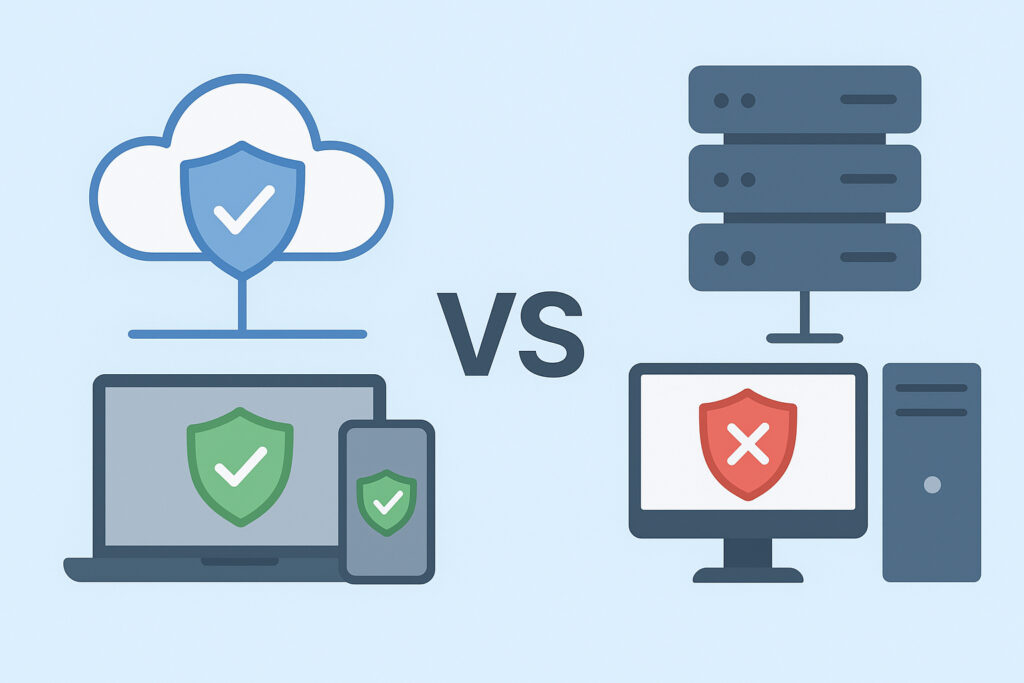
If you’re responsible for keeping your company’s devices secure, you’ve probably wrestled with this question: should you go with cloud-managed endpoint security or stick with on-premise solutions? It’s not just a technical decision—it affects your budget, your team’s workload, and how quickly you can respond when something goes wrong.
I’ve seen both approaches in action, and honestly, there’s no one-size-fits-all answer. But understanding the real-world trade-offs can help you make the right call for your situation.
What We’re Really Comparing Here
Cloud-managed endpoint security means your protection runs from someone else’s servers. You log into a web dashboard, manage everything remotely, and the vendor handles the infrastructure. Think of services where you’re monitoring and protecting all your employees’ laptops and phones without installing a single server in your office.
On-premise solutions put you in the driver’s seat. You own the hardware, the software runs on your servers, and your data stays within your four walls. It’s the traditional approach that many organizations grew up with.
The Cloud-Managed Approach: What You Gain
Speed of deployment is probably the biggest win. I remember helping a mid-sized company roll out protection to 150 devices across three countries. With cloud management, we had everyone covered in about two days. No shipping servers, no complex network configuration—just install the agent and you’re done.
Lower upfront costs matter, especially for smaller teams. You’re not buying servers, storage arrays, or backup systems. You pay a predictable monthly fee per device. For a company with 50 employees, that might mean spending €15-25 per device monthly instead of dropping €10,000+ on hardware upfront.
Automatic updates happen without your IT team lifting a finger. New malware signatures, security patches, feature improvements—they all roll out automatically. This is huge when a zero-day vulnerability hits and you need protection immediately, not next maintenance window.
Remote management becomes trivial. Your sales rep’s laptop in Spain has an issue? You can investigate, scan, and remediate from your desk in Helsinki. During the pandemic, this capability went from “nice to have” to absolutely essential.
Scalability is built in. Hiring 20 new people? Just add 20 more licenses. Opening an office in another country? Same management console, same policies, no additional infrastructure.
But Cloud Isn’t Perfect
Internet dependency is real. I’ve seen situations where a site lost internet connectivity and suddenly couldn’t push policy updates or investigate potential threats. Your endpoints still have local protection, but central management goes dark.
Data privacy concerns vary by industry. If you’re handling sensitive health records or financial data under strict regulations, sending security telemetry to cloud servers might require extra legal review. Some compliance frameworks explicitly require on-premise data processing.
Subscription costs add up over time. That €20 monthly fee per device seems reasonable until you multiply it by 500 devices over five years. You’re looking at €600,000 versus maybe €150,000 for on-premise (though this math gets complicated when you factor in staff time and maintenance).
Less control over timing can frustrate some IT teams. When the vendor pushes an update, you get it—sometimes whether you’re ready or not. I’ve heard about updates rolling out during business hours that briefly impacted performance.
The On-Premise Case: Why Some Still Choose It
Complete data control means everything stays in your building. For organizations in regulated industries or those handling genuinely sensitive information, this matters legally and practically.
No internet required for core functionality. Your security keeps working even if your connection to the outside world goes down. Management and updates might wait, but protection doesn’t.
Customization options can be deeper. You can tweak configurations, integrate with legacy systems, and modify things in ways cloud services don’t always allow.
One-time costs might work better for your accounting. Some organizations prefer capital expenditures they can depreciate rather than ongoing operational expenses.
The On-Premise Reality Check
Initial investment hits hard. Servers, storage, backup systems, software licenses—you’re looking at significant upfront spending before you protect a single device.
Staff requirements are non-negotiable. Someone needs to maintain those servers, apply patches, monitor performance, and be on call when things break. This is where the “lower total cost” argument for on-premise often falls apart.
Update delays create risk. You need to schedule maintenance windows, test updates, and coordinate deployments. Meanwhile, attackers aren’t waiting for your change control process.
Scaling is manual. Opening a new office means shipping hardware, configuring networks, and possibly hiring local IT support.
What Actually Matters for Your Decision
Company size is a big factor. If you have fewer than 200 devices and limited IT staff, cloud management usually makes more sense. The time your small team saves pays for itself quickly.
Geographic distribution matters too. Multiple offices across different countries? Cloud management means consistent protection without infrastructure everywhere.
Compliance requirements might decide for you. Some regulations effectively mandate on-premise. Check with your legal and compliance teams before committing.
IT team capacity is often the real bottleneck. Can your team handle another on-premise system? Be honest—many teams are already stretched thin.
The Hybrid Middle Ground
Some organizations split the difference. Critical servers stay on-premise with traditional security, while employee laptops and mobile devices get cloud-managed protection. This gives you control where you need it and convenience where it helps most.
Common Misconceptions Worth Clearing Up
“Cloud is less secure” – Actually, reputable cloud security vendors often have better security than most individual companies can implement. They have dedicated security teams, 24/7 monitoring, and handle threats at massive scale.
“On-premise is always cheaper long-term” – Maybe, if you ignore staff time, opportunity costs, and the risk of delayed security updates. Run the real numbers including salary costs.
“We need on-premise for compliance” – Sometimes true, but many compliance frameworks have updated to accept cloud solutions with proper controls. Double-check current requirements.
My Take After Seeing Both
For most organizations today, cloud-managed endpoint security makes practical sense. The deployment speed, automatic updates, and reduced management overhead outweigh the downsides. But if you’re in a heavily regulated industry, have specific data sovereignty requirements, or already have robust IT infrastructure and staff, on-premise might still be your best bet.
The key is being honest about your actual situation—not the situation you wish you had.