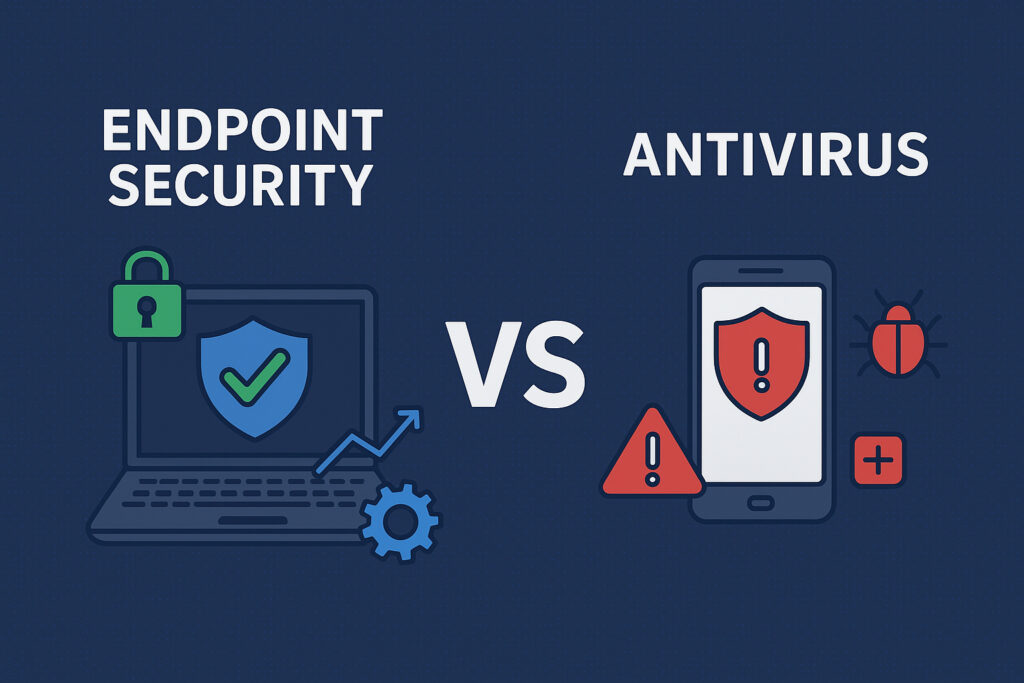
When I first started working with cybersecurity solutions, I thought antivirus software was pretty much all you needed. Install it, let it scan for viruses, and you’re good to go, right? Well, that’s what most people think, but the reality is quite a bit more complex these days.
Traditional antivirus software has been around since the late 1980s. It works by scanning files and comparing them against a database of known malware signatures. Think of it like a bouncer at a club who has a list of troublemakers and won’t let them in. It’s straightforward, and for a long time, it worked pretty well.
Endpoint security, on the other hand, is a much broader approach. It’s not just about catching viruses anymore. It’s about protecting every device that connects to your network – laptops, smartphones, tablets, you name it – from a whole range of modern threats that antivirus alone simply can’t handle.
Why Antivirus Isn’t Enough Anymore
The problem with traditional antivirus is that cyber threats have evolved way past simple viruses. Today’s attackers use ransomware, zero-day exploits, fileless malware, and sophisticated phishing schemes. Many of these threats don’t even have a signature to detect because they’re brand new or they don’t behave like traditional malware.
I remember dealing with a client a few years back who had decent antivirus protection but still got hit by a ransomware attack. The malware got in through a phishing email, and by the time the antivirus caught it, several files were already encrypted. That’s when I really understood that signature-based detection alone just doesn’t cut it in 2025.
What Endpoint Security Actually Does
Endpoint security takes a much more comprehensive approach. Yes, it includes antivirus capabilities, but it adds several other layers of protection on top of that.
First, there’s behavioral analysis. Instead of just looking for known threats, endpoint security watches how programs behave. If something starts acting suspiciously – like trying to encrypt a bunch of files rapidly – it can stop it before real damage happens.
Then you’ve got application control, which lets you decide which programs can run on your devices in the first place. There’s also device control, so you can prevent employees from plugging in random USB drives that might be infected.
Real-time monitoring is another huge piece. With proper endpoint security, you can see what’s happening across all your devices at any given moment. If there’s unusual network activity or someone’s trying to access files they shouldn’t, you know about it immediately.
The Integration Factor
Here’s something else that matters: endpoint security solutions typically integrate with other security tools and provide centralized management. If you’re managing security for multiple devices – which most businesses are – you need a single dashboard where you can see everything, push updates, and respond to threats quickly.
Traditional antivirus usually works in isolation. Each device does its own thing, and there’s no big-picture view of your security posture.
So Which One Do You Need?
For personal use on a home computer, a good antivirus might still be adequate. But for any business environment or if you’re handling sensitive data, endpoint security is really the minimum you should consider.
The threat landscape has changed dramatically. We’re not just dealing with viruses anymore – we’re dealing with targeted attacks, insider threats, data breaches, and increasingly sophisticated cybercriminals. You need security that can adapt and respond to threats that don’t even exist yet.
Think of antivirus as locking your front door, while endpoint security is locking your doors, installing cameras, having motion sensors, and maybe even hiring a security guard. Both approaches lock the door, but only one gives you comprehensive protection.
The bottom line is this: antivirus is a component of endpoint security, not a replacement for it. In today’s environment, having comprehensive endpoint protection isn’t just good practice – it’s essential for keeping your business and data safe.