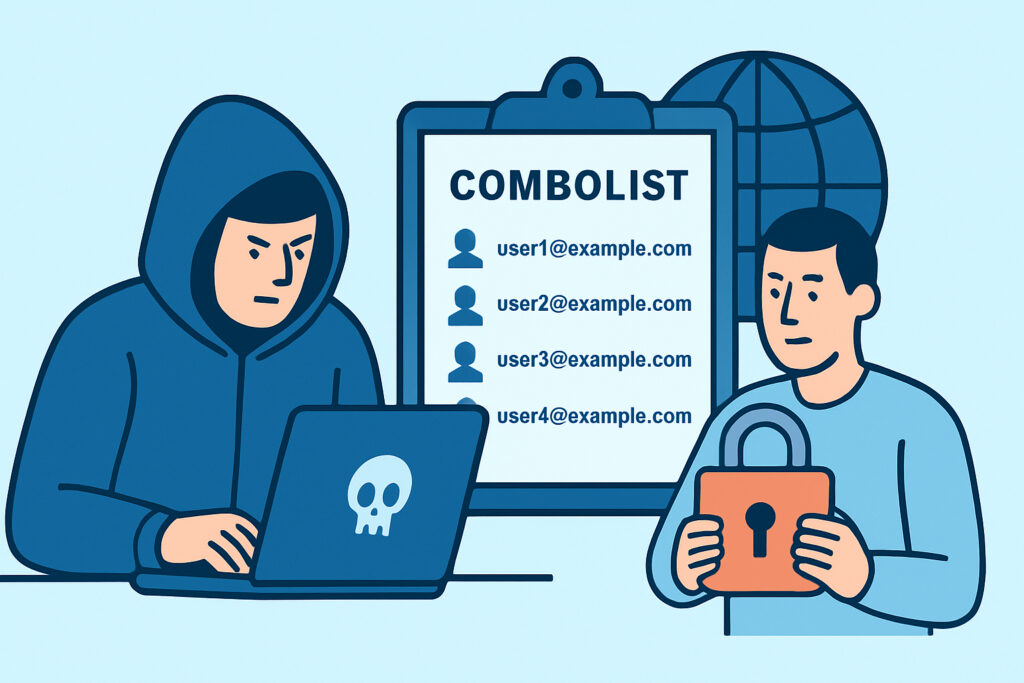
A combolist is one of the simplest tools in a criminal’s toolkit, and also one of the most dangerous – a plain text file pairing usernames or email addresses with passwords, harvested from old breaches and stitched together for reuse. For a security team trying to understand where leaked credentials end up and how they get weaponized, knowing the anatomy of a combolist is the difference between reacting to an incident and preventing one.
Most people picture data breaches as isolated events – a single company loses a database, the data circulates briefly, then fades. In practice, that stolen data rarely stays in one place. It gets merged with dozens of other breaches, deduplicated, reformatted, and redistributed as combolists that outlive the original incident by years.
What Exactly Is a Combolist
A combolist – short for “combination list” – is a text file structured as email:password or username:password pairs, one per line. Some are small, a few thousand entries scraped from a single forum leak. Others run into the hundreds of millions, compiled from dozens of breaches spanning a decade or more.
The format is deliberately minimal because it needs to work with automated tools. There is no encryption, no obfuscation, just raw pairs separated by a colon or comma. This simplicity is exactly what makes combolists so easy to produce, trade, and feed directly into attack scripts.
Combolists differ from raw breach dumps in one important way. A breach dump is the original data as stolen – often including hashed passwords, internal IDs, and metadata specific to that one company. A combolist is the cleaned-up, cracked, and repackaged product built from one or more of those dumps, ready for immediate use rather than further processing.
How Criminals Build Them
Building a combolist follows a fairly consistent pipeline, and understanding it helps explain why the practice is so persistent.
Collection – Attackers pull data from breach dumps circulating on hacker forums, marketplaces, and paste sites, plus credentials harvested by infostealer malware running on infected devices.
Cracking – If passwords were stored as hashes, they get run through cracking tools like hashcat against wordlists and rainbow tables. Weak or reused passwords fall quickly; a surprising number crack within hours.
Merging and deduplication – Multiple sources get combined into one file, with duplicate entries stripped out and formatting normalized so the list works uniformly across attack tools.
Filtering – Some combolists get segmented by domain, region, or industry – a “combolist” of only .edu emails, or only entries tied to a specific country’s telecom providers, for example. This targeting makes the list more valuable to a specific buyer.
Validation – Before selling or using a list, criminals often “check” it against live login pages using automated tools, removing dead credentials and confirming which ones still work. A validated list, sometimes marketed as a “hit list,” commands a much higher price than a raw, unchecked one.
For more detail on how stolen databases surface and circulate before they even reach this stage, see how database dumps get posted and traded on hacker forums.
Why Combolists Are So Attractive to Attackers
The appeal comes down to economics. Building a combolist from scratch requires almost no original hacking skill – the raw material already exists in old breaches, and free or cheap tools handle the cracking and merging. What criminals are really selling is convenience and scale.
A validated combolist turns credential theft into a numbers game. Because a large percentage of people reuse passwords across multiple services, an attacker doesn’t need to breach a target directly. They just need to try credentials stolen from an unrelated site against the target’s login page, an approach commonly called credential stuffing. It works often enough, against enough accounts, to be profitable even with a low success rate.
This is also why combolists have such long shelf lives. A breach from five or six years ago can still cause damage today if any of those old credentials were never changed and get reused elsewhere. A password set once and forgotten is a liability that doesn’t expire on its own.
Busting the Myth: “Old Breaches Don’t Matter Anymore”
A common misconception is that once a breach is old news, the exposed data loses its value and stops posing a threat. That’s not how combolists work.
Attackers actively re-mine old breaches, combining them with newer ones to build fresh lists that catch people who changed their password on the breached site but reused the old one somewhere else. A credential from a 2016 leak can still be sitting in a combolist trading hands in 2026, and it will keep working until the person who owns it – or someone monitoring on their behalf – notices and forces a change.
Security teams that only track their most recent incident response cases and dismiss historical breaches as resolved are leaving a real gap. Continuous monitoring across both new and older leak sources matters precisely because combolists have no expiration date.
What This Means for Defenders
Combolists put the burden of defense on password hygiene and detection speed. Multi-factor authentication blunts most credential stuffing attempts, even when the password itself is correct, so it should be treated as a baseline control rather than an optional extra.
Beyond that, organizations benefit from knowing when their employees’ or customers’ credentials appear in circulating lists, rather than waiting for a wave of failed logins or account takeovers to signal the problem. Once an exposure is confirmed, the practical response is straightforward: force a reset on the affected accounts and review the broader approach to rotating passwords after a leak alert so the same credentials don’t quietly resurface in the next merged list.
Frequently Asked Questions
Is a combolist the same thing as a data breach?
No. A data breach is the original theft of data from a specific organization. A combolist is a downstream product, often built by merging credentials from many different breaches into one usable file.
How do I know if my organization’s credentials are in a combolist?
The most reliable way is continuous monitoring of forums, marketplaces, and paste sites where these lists circulate, since combolists rarely announce themselves and can sit unnoticed for months before being used in an attack.
Does changing a password once remove it from a combolist?
No. Old entries typically stay in circulation indefinitely, since criminals keep redistributing and remixing lists. Changing the password only stops that specific entry from working – it does not get deleted from the files already in circulation.
Combolists persist because they are cheap to build and profitable to use, recycling old exposures into new attacks long after the original breach has been forgotten. Treating credential exposure as a one-time event rather than an ongoing risk is the mistake that keeps these lists effective, which is why ongoing visibility into where your organization’s data surfaces matters as much as the initial incident response.