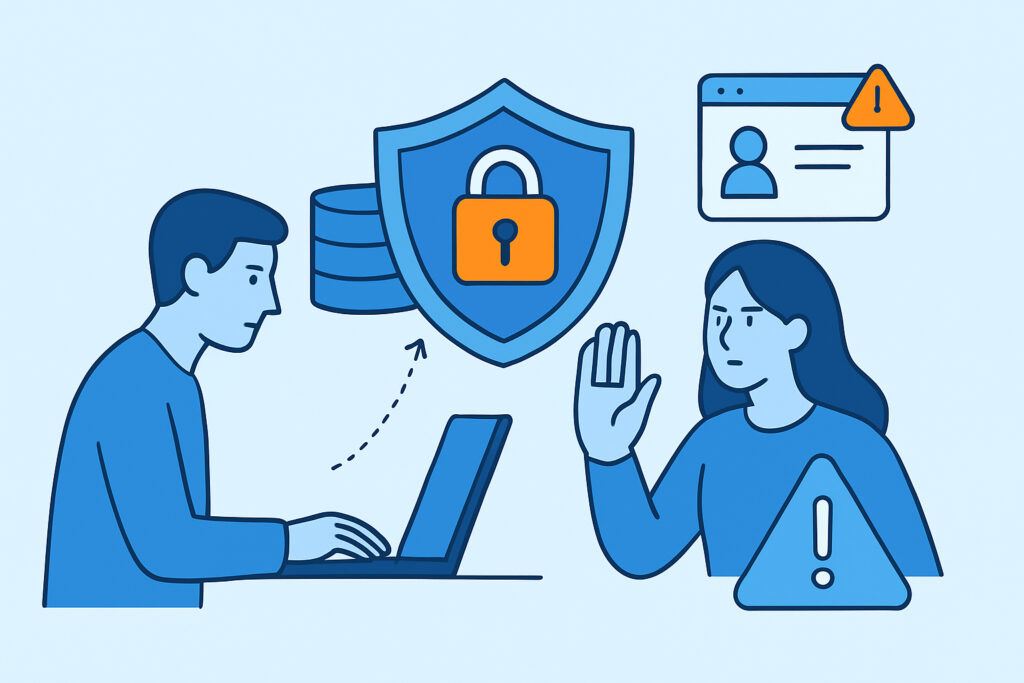
Lateral movement after a credential leak is one of the most dangerous – and underestimated – phases of a network compromise. When attackers obtain valid credentials, they rarely stop at the account they’ve breached. They probe, pivot, and escalate until they reach high-value targets: administrative accounts, file servers, databases, or cloud environments. Understanding how to contain the damage quickly can mean the difference between an isolated incident and an organization-wide breach.
How Attackers Exploit a Single Credential
A leaked set of credentials is rarely just an email and password. Depending on the account, it can be a master key. Attackers authenticate as the legitimate user, then use that access to enumerate internal systems, map network shares, access connected SaaS platforms, and abuse trust relationships between services.
In environments where single sign-on (SSO) is widely deployed, one valid credential can unlock dozens of applications simultaneously. Attackers know this. They move quietly, avoid triggering alerts, and often spend days or weeks establishing footholds before anyone notices something is wrong.
Leaked VPN credentials represent a particularly dangerous entry point – once inside the network perimeter, lateral movement becomes significantly easier because internal controls tend to be far less strict than perimeter defenses.
Why Speed Defines the Outcome
The first 24–48 hours after a credential leak is detected are critical. Research consistently shows that attackers who establish persistence early – creating new accounts, installing remote access tools, or exfiltrating data – dramatically increase the cost and complexity of containment.
A credential that surfaces in a dark web dump may have already been in circulation for weeks. By the time a security team detects it, the attacker may have already moved laterally, exfiltrated data, or established backdoors. This is why having a tested incident response playbook ready before an incident occurs is not optional – it’s fundamental.
Every hour of delayed response widens the blast radius. Teams that contain within four hours typically see far fewer secondary compromises than those that take 24 hours or more.
Step-by-Step Containment After a Credential Leak
Containment is not just about locking out the attacker – it’s about doing so without tipping them off prematurely and without disrupting legitimate operations. A structured approach matters here.
Step 1 – Verify and scope the leak. Confirm which credentials were exposed, from which source, and how long they may have been available. Check credential dumps, paste sites, and breach databases. Determine whether the credentials are still valid and in active use.
Step 2 – Preserve evidence before touching anything. Before forcing password resets, capture logs from authentication systems, VPN gateways, SSO platforms, and cloud consoles. Resetting credentials prematurely can destroy forensic evidence you will need later.
Step 3 – Identify active sessions and connected devices. Query your identity provider, Active Directory, or cloud IAM for active sessions tied to the compromised account. Look for sessions from unusual IP addresses, unexpected geographies, or unfamiliar device fingerprints.
Step 4 – Revoke sessions and rotate credentials simultaneously. Invalidate all active sessions and rotate the password in a coordinated action. If the account has API keys, OAuth tokens, or service account credentials, rotate those as well. Partial rotation is one of the most common containment failures.
Step 5 – Review accounts created or modified after initial compromise. Attackers often create secondary accounts or modify dormant accounts as persistence mechanisms. Check for new administrative accounts, changes to group memberships, and modifications to MFA settings.
Step 6 – Audit connected SaaS and cloud environments. Check for unusual OAuth app authorizations, newly granted permissions, or configuration changes in cloud consoles. Lateral movement increasingly happens across SaaS boundaries, not just inside the corporate network.
Step 7 – Segment and monitor before cutting access. Rather than immediately blocking all access, consider briefly monitoring suspicious sessions – under legal and policy guidance – to understand the full scope of attacker activity before cutting them off completely.
The Myth That a Password Reset Closes the Incident
This is the most dangerous misconception in credential breach response: that forcing a password reset resolves the situation. It does not.
Attackers anticipate this move. Within hours of gaining access, experienced threat actors will have established persistence through multiple channels – new backdoor accounts, stolen session cookies, OAuth app grants that survive password resets, or remote access tools installed on endpoints reached during lateral movement.
A password reset removes one door. It rarely removes all of them. Effective containment requires auditing every access path associated with the compromised account, not just the password itself.
Monitoring for Residual Attacker Activity
After the initial containment steps, active monitoring is essential. Lateral movement leaves traces, and knowing what to look for makes a significant difference in detecting whether the threat has been fully removed.
Watch for authentication attempts across multiple internal systems in rapid succession – especially outside business hours. Look for privilege escalation events: accounts accessing resources they have never touched before. Monitor for unusual data transfer volumes, particularly toward external destinations or cloud storage.
Rotating credentials after a leak alert is necessary, but it must be paired with active monitoring for residual attacker behavior. Rotating credentials on the original compromised account while an attacker continues operating under a secondary account they created is a scenario that gets missed more often than most teams expect.
Also monitor endpoints. If lateral movement reached workstations or servers, there may be malware artifacts, scheduled tasks, or registry modifications that survive credential rotation entirely.
Frequently Asked Questions
How quickly can an attacker move laterally after a credential leak?
In many documented incidents, lateral movement begins within hours of initial access – sometimes within minutes if automation tools are involved. Attackers using credential stuffing infrastructure can test and pivot across systems rapidly. Assuming you have days to respond is a mistake that often turns a minor incident into a significant breach.
Does multi-factor authentication prevent lateral movement after a credential leak?
MFA significantly raises the barrier to initial access, but it does not fully prevent lateral movement once an attacker is inside. If an attacker established a persistent session before MFA was enforced, or has compromised an endpoint where MFA tokens are generated, the protection is partial. MFA is a critical control, not a complete containment solution on its own.
How do you determine whether lateral movement has already occurred?
Look for authentication events on systems the compromised account does not normally access, changes to account permissions or group memberships, and new accounts or service principals created after the estimated leak window. Log correlation across identity, network, and endpoint sources is the most reliable detection method available.
Containment Is a Process, Not a Single Action
Credential leaks are not resolved by a password reset or a single account lockout. Effective containment after lateral movement requires scoping the full extent of attacker access, rotating every credential and token associated with the compromised account, auditing secondary persistence mechanisms, and maintaining active monitoring through the recovery period.
The security teams that handle these incidents well treat containment as a multi-step process with clear ownership at each stage – not a checkbox to tick. Building and rehearsing that process before an incident occurs is what separates a contained event from an organization-wide compromise.